TÜV Rheinland Onsite-Verified Manufacturer Yueqing, Zhejiang, China
Active PFC DIN Rail Power Supply for high-density industrial control cabinets
PF > 0.98 · EN 61000-3-2 Compliance

Active PFC DIN Rail Power Supply: Engineering Architecture, Selection Criteria, and Procurement Directives for Next-Generation Automation

Direct factory manufacturing of ultra-compact TS35 DIN rail units (120W to 960W) engineered for zero grid harmonic distortion, 94% peak conversion efficiency, and extreme thermal resilience in sealed industrial enclosures.

Industrial switching power supplies produced by Yueqing Keldan Technology Co., Ltd.
TÜV Rheinland Onsite-Verified

Factory-Direct Heavy Industrial SMPS Solutions

Standardized and bespoke power solutions designed to eliminate field downtime and withstand severe inductive line surges.

0+Years in Power Electronics
0Verified Staff Onsite
TÜVRheinland Onsite Audited
>0.98Power Factor Correction
Technical Insight & Information Gain

The Engineering Imperative Behind Active PFC in Modern Control Cabinets

Why modern global automation architectures mandate active power factor correction over legacy passive topology to safeguard grid integrity and eliminate premature hardware burnout.

Harmonic Distortion vs. Sinusoidal Grid Synchronization

In conventional switched-mode power supplies without Active PFC, standard AC input rectification creates short, discontinuous peak current pulses. These current spikes do not match the sinusoidal AC input voltage waveform, resulting in an exceptionally poor displacement power factor (often falling between 0.55 and 0.65) and injecting massive Total Harmonic Distortion (THD) back into the facility power line. High harmonic current frequencies circulate across neutral conductors, generating excessive resistive I²R heat losses, tripping upstream miniature circuit breakers (MCBs), and introducing destructive electromagnetic interference (EMI) across sensitive analog sensors and PLC communications.

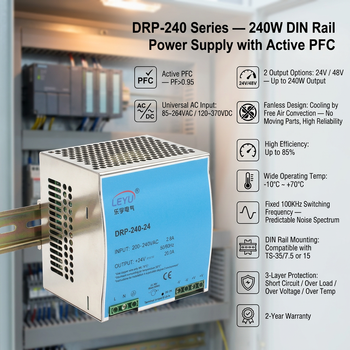
An Active PFC DIN Rail Power Supply integrates a dedicated continuous conduction mode (CCM) or transition mode (TM) boost pre-regulator circuit immediately after the input bridge rectifier. Utilizing an advanced power factor controller IC paired with high-voltage silicon MOSFETs and high-frequency powdered magnetic core inductors, our power supply dynamically sculpts incoming AC line current into an ultra-clean sinusoidal profile running precisely in-phase with line voltage. By forcing the apparent power (kVA) to almost perfectly match the real active power (kW), our Active PFC series sustains a Power Factor (PF) of greater than 0.98 across universal AC inputs (85V to 264V AC).

For systems drawing continuous active power exceeding 75 Watts, compliance with European Directive EN 61000-3-2 (Class A and Class D harmonic emissions) is legally enforced. Yueqing Keldan Technology Co., Ltd. architects every Active PFC unit to comfortably surpass these standards, shielding systems against export regulatory blockades and ensuring pristine electrical compatibility inside mission-critical installations.
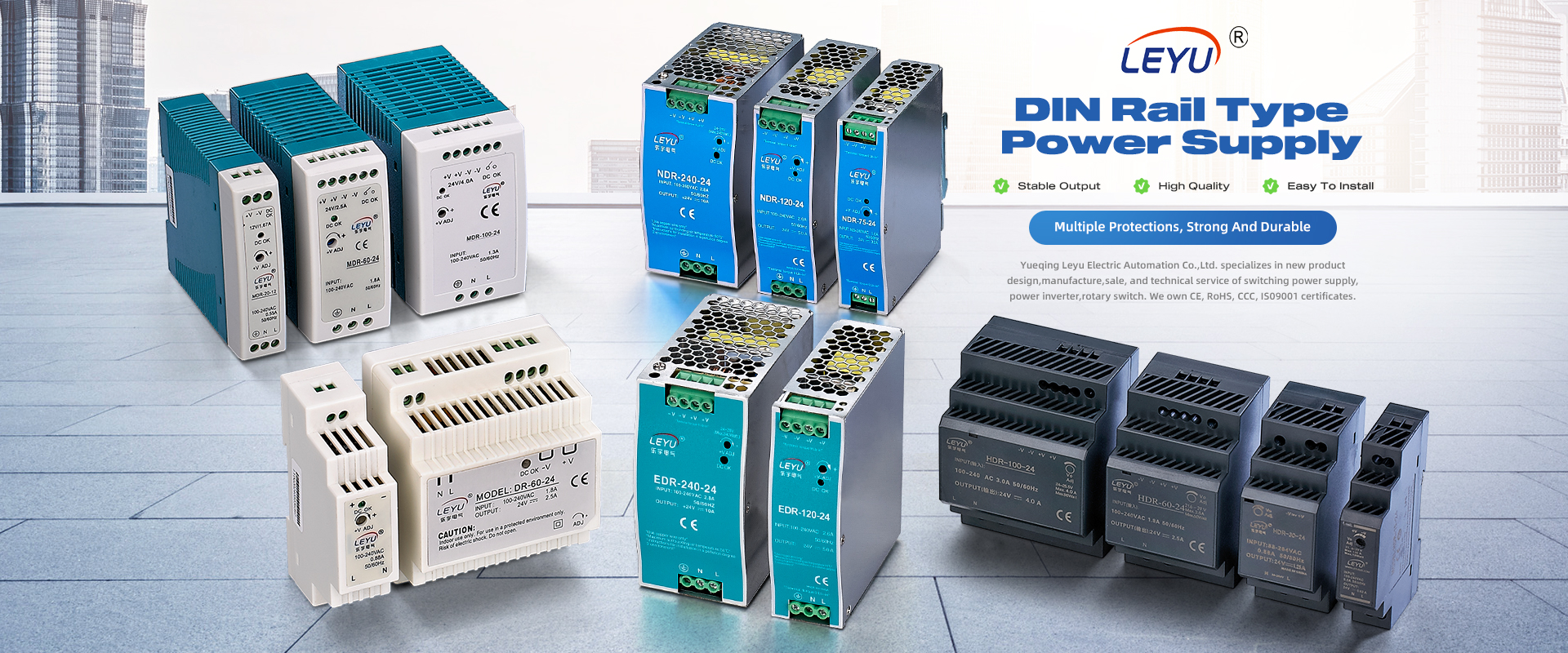
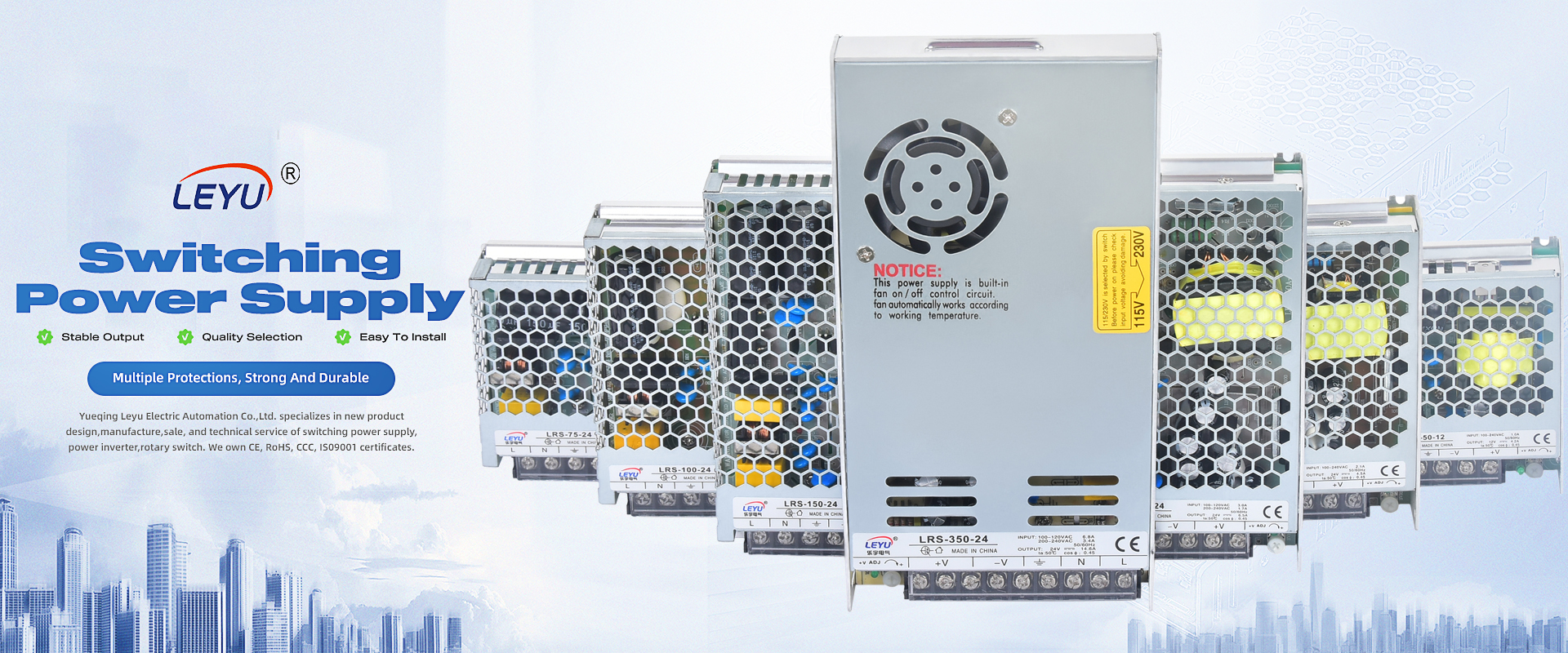
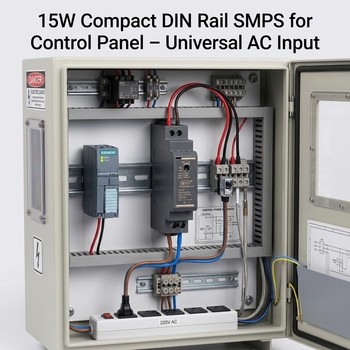
Active PFC DIN Rail Power Supply mounted inside industrial control enclosure

Root-Mean-Square (RMS) Optimization

Active PFC curtails peak input currents by over 30% compared to non-PFC supplies. Lower RMS input current allows electrical panel builders to downsize wire gauges, down-rate distribution fuses, and integrate more modules onto an individual branch line.

Cabinet Heat Minimization

By eradicating circulating reactive currents, internal losses across the bulk capacitor, bridge diodes, and copper traces drop drastically. The result is a substantial 15% to 25% reduction in internal thermal generation inside sealed control panels.

Universal Wide-Range Input

Active PFC topologies natively step-up input DC bus voltages to a stable 380V-400V DC rail internally. This provides inherent universal AC line operation (85–264VAC) without requiring manual 115V/230V selector slider switches prone to operator error.

Holdup Time Integrity

Operating a high, tightly regulated internal intermediate DC bus allows storage capacitors to deliver significantly longer holdup times (>25ms at full rated load), successfully bridging brownouts and momentary grid dips without resetting industrial PLCs.

Architecture Comparison

Active PFC vs. Passive PFC vs. Non-PFC: The Procurement Decision Matrix

Understand the quantitative differences across electrical metrics, operational heat dissipation, weight, and international compliance factors.

Comprehensive Technical Performance & Selection Matrix
Performance Metrics Active PFC DIN Rail PSU (DRP Series) Passive PFC Power Supplies Standard Non-PFC Switching PSU
Power Factor (PF Rating) 0.96 to 0.99 across all load ranges 0.70 to 0.80 (load dependent) 0.50 to 0.65 (severe phase lag/distortion)
Total Harmonic Distortion (THD) < 8% - 10% (Sinusoidal in-phase) 25% to 45% (Noticeable waveform flattening) > 70% to 110% (Extreme current spike pulses)
AC Input Voltage Range Universal wide input (85–264V AC continuous) Narrow input band; or manual toggle switch Narrow band or manual selector slider switch
EN 61000-3-2 Compliance Full Class A, B, C & D compliance (>75W) Partial / Marginal Class A compliance Fails compliance above 75W active load
Internal Thermal Generation Minimal; lowest continuous I²R heating Moderate; choke core heating losses High; extreme RMS line current heating
Physical Enclosure Mass / Weight Lightweight compact high-frequency build Bulky, heavy line-frequency (50/60Hz) choke Moderate size, low weight
Input Inrush Current Magnitude Integrated NTC + Active Inrush Soft-Start Standard series thermistor suppression High raw inrush current surge
Suitability in High-Density Panels Optimal: minimal clearance requirements Sub-optimal: heavy magnetic flux emissions Poor: high thermal derating needed
Enterprise Authority & Production Capability

Yueqing Keldan Technology Co., Ltd. — Your Audited Manufacturing Partner

Operating inside Yueqing, Wenzhou—China's global capital for electrical control hardware—we fuse 18+ years of engineering mastery with stringent TÜV Rheinland onsite-audited manufacturing integrity.

Verified Custom Manufacturer

Onsite Audited SMT, Assembly, and Full-Load Testing

Unlike trading intermediaries, Yueqing Keldan Technology Co., Ltd. operates direct high-speed SMT surface-mount lines, automated optical inspection (AOI) stations, lead-free nitrogen reflow ovens, and intelligent multi-channel burn-in aging racks under an integrated Quality Management System.

Our production site has been independently audited and verified onsite by TÜV Rheinland. With a committed workforce of 44 verified production and technical staff, plus an R&D engineering division boasting over 5+ years of specialized SMPS and Active PFC design experience per engineer, we deliver rock-solid consistency across batch volumes ranging from custom small runs to 100,000+ unit OEM supply contracts.

  • TÜV Rheinland Onsite Verified Facility
  • Full In-House SMT, AOI & Wave Soldering
  • 100% Full-Load High-Temp Burn-in Testing
  • Direct Custom OEM / ODM Engineering
  • Full CE, RoHS & EN 61000 Harmonized Testing
  • 12-Specialist Global Export Logistics Team

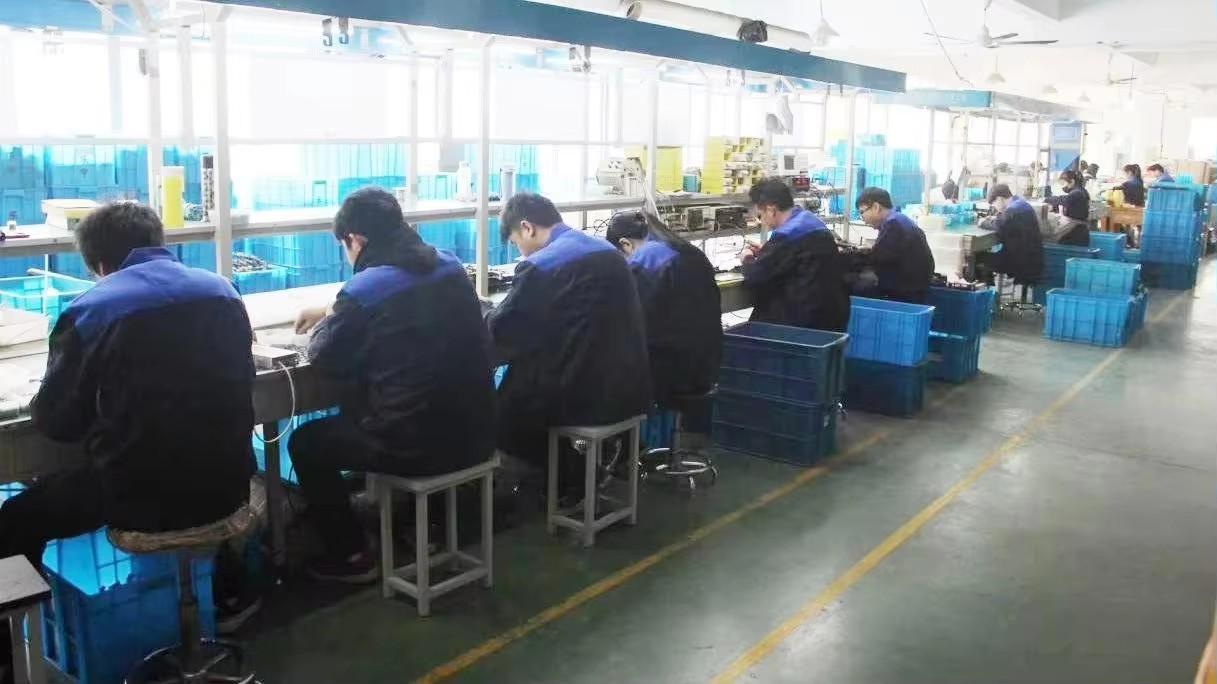
Inside Our Yueqing Manufacturing Lines

Workshop Production Floor & Logistics Overview

Zero-Defect Quality Gates

8-Step Quality Assurance for High-Reliability Active PFC PSUs

Every single power unit passing through our Yueqing lines is subjected to thorough, multi-gate automated verification and thermal screening.

IQC Material Screening

100% incoming inspection of key components: 105°C long-life electrolytic capacitors, tier-one MOSFETs, magnetic cores, and high-frequency diodes.

High-Speed SMT Placement

Automated precision surface-mount technology ensures exact deposition of solder paste and error-free component positioning across high-density circuit boards.

Nitrogen Reflow Soldering

Carefully profiled multi-zone thermal curves guarantee void-free solder joints, eliminating cold joints and micro-fractures under extreme thermal cycles.

Automated Optical Inspection (AOI)

Advanced vision systems inspect every trace, solder fillet, resistor value, and capacitor polarity, instantly isolating micro-bridging or component misalignments.

Through-Hole Manual Welding

Certified assemblers solder high-power toroidal inductors, Active PFC boost chokes, and input terminal blocks with continuous process monitoring.

Dynamic Step Calibration

Automated test fixtures fine-tune output voltages, trim feedback loops, and verify active power factor correction, ensuring PF > 0.98 and tight load regulation.

100% Full-Load Burn-In Test

Units are placed inside heated burn-in chambers under 100% full rated electrical load for a minimum of 4 hours to provoke and weed out infant-mortality defects.

OQC Final Outbound Audit

Dielectric withstand insulation test (Hi-Pot 3.0kV AC isolation), ground continuity check, physical aesthetics, terminal torque testing, and export packaging verification.

Procurement Engineering FAQ

Technical Questions Global Buyers Ask When Sourcing Active PFC DIN Rail PSUs

Direct, unhedged technical answers prepared by our application engineering team to support your component specification and vendor qualification.

Why is an Active PFC DIN Rail Power Supply strictly mandatory for automation systems drawing over 75W?
International harmonized standards—most prominently European Standard EN 61000-3-2 and IEC 61000-3-2 (Class A, C, and D)—legally govern the harmonic current content emitted into the low-voltage public grid by any electrical load drawing 75W or greater. Without active power factor correction, capacitive input filters in conventional switching power supplies cause jagged current spikes, which push harmonic levels far above legal thresholds. Equipping cabinets with Active PFC corrects the waveform to a true sine curve in phase with voltage (PF > 0.98), enabling effortless CE/UL compliance while eliminating regulatory barriers at destination customs.
How does an Active PFC supply reduce total operating costs and prevent panel overheating?
In non-PFC or passive PFC configurations, low power factors (0.55–0.65) require the supply lines to transmit substantial 'reactive' (non-working) current to deliver the needed active watts. This circulating reactive power produces severe I²R resistive heat losses in internal transformers, input rectifiers, terminal blocks, and cabling. An Active PFC supply slashes RMS input current by up to 35%, cutting internal thermal dissipation by 15% to 25%. In sealed enclosures with IP54 or IP66 ingress protection, this prevents thermal runaway, avoids the need for costly external cabinet air conditioning, and doubles the operating lifespan of surrounding PLCs and electrolytic capacitors.
What are the key differences between Active PFC and Passive PFC on TS35 DIN rail mounts?
Passive PFC utilizes a heavy, bulky line-frequency (50/60Hz) iron-core inductor placed directly in series with the input. While cost-effective, it only corrects the power factor to roughly 0.70–0.80, adds excessive deadweight to the TS35 DIN rail (increasing risk during vibration/transport), and only operates across a narrow AC voltage band. Active PFC, by contrast, uses advanced high-frequency (65kHz–100kHz+) boost switching semiconductor technology. It delivers PF > 0.98 across universal 85–264V AC inputs, offers low weight, compact module width, and features active dynamic surge immunity.
Can Keldan Active PFC DIN Rail supplies handle inductive inrush from motors and contactors?
Yes. Yueqing Keldan Technology Co., Ltd. specifically designs the DRP series with dynamic peak overload capabilities. Our modules deliver up to 150% peak rated current for up to 3 seconds. This allows control cabinets to absorb startup inrush currents demanded by inductive relay coils, stepper drives, servo motors, and capacitive DC-bus banks without dropping the 24V DC bus voltage or triggering latch-off protection faults.
What OEM / ODM customization options does Yueqing Keldan Technology Co., Ltd. offer?
We offer comprehensive hardware and branding customization: specific DC voltage calibrations (e.g., 12V, 24V, 36V, 48V, or dual rails); customized conformal PCB coatings for high-humidity or harsh saline operating environments; private label silk-screen branding; custom screw-clamp or spring-push terminal blocks; bespoke packaging; and pre-configured parallel load-sharing ORing diodes for redundant N+1 power architectures.
What is your standard production lead time and Minimum Order Quantity (MOQ)?
Standard Active PFC DIN rail models can be sampled immediately with an MOQ starting from just 1 piece for engineering validation. Standard batch production orders typically ship within 12 to 18 business days. Custom OEM/ODM projects requiring bespoke PCB layouts or specialized mechanical enclosures follow a structured 20-to-30 day prototype validation pipeline.

Accelerate Your Project with Audited Active PFC Power Hardware

Connect directly with our engineering division in Yueqing. Review full datasheets, electrical schematics, EMC test certificates, and factory-direct volume pricing.

Get Catalog