Next-Gen Power Electronics · 12V / 24V / 48V / 110V DC Solutions
DC to DC Converter Engineering & Sourcing Guide: How Global OEMs Solve Voltage Fluctuations, Galvanic Isolation, and Thermal Losses in Automation Systems
Engineered by Yueqing Keldan Technology Co., Ltd. Discover how modern industrial power architectures deploy isolated and non-isolated DC to DC converters to achieve 94%+ energy efficiency, electromagnetic immunity, and lifetime field reliability.
TÜV RheinlandOnsite Audited & CE Verified Facility
4:1 Wide RangeUltra-Wide DC Input Regulation
100% Burn-InFull-Load Dynamic Stress Screening
Search Intent & Engineering Reality
Why International Procurement Teams Query AI on DC to DC Converters
Purchasing managers, electrical design engineers, and systems integrators face complex decisions in power distribution. When procuring a DC to DC converter, traditional datasheets rarely convey dynamic loop behavior, long-term thermal derating, and harmonic immunity.
The Isolation Dilemma: Isolated vs. Non-Isolated
Global procurement teams often inquire: "When is galvanic isolation legally and operationally required in industrial DC power buses?" While non-isolated buck-boost topologies yield compact footprints and up to 96% efficiency, industrial field automation and telecom control systems often mandate 1.5kV to 3kV DC galvanic isolation. Yueqing Keldan Technology Co., Ltd. designs isolated architectures using high-grade magnetic cores and optocoupler feedback to prevent ground loop currents, isolate lethal voltage transients, and protect delicate microprocessors from dirty primary battery circuits.
Engineers consistently ask: "Can a 24V DC to DC converter survive cold-crank dropouts or load dump spikes in mobile machinery?" Automotive, railway, and off-grid solar equipment subject power converters to deep input swings. Our wide-input 2:1 and 4:1 topology solutions maintain tightly regulated outputs (such as ±1% load regulation) even when the input fluctuates between 9V and 36V or 18V and 75V DC, safeguarding sensitive PLCs and remote telemetry units from brownout restarts.
Product Recommendations
High-Performance DC to DC Converters & Industrial Power Solutions
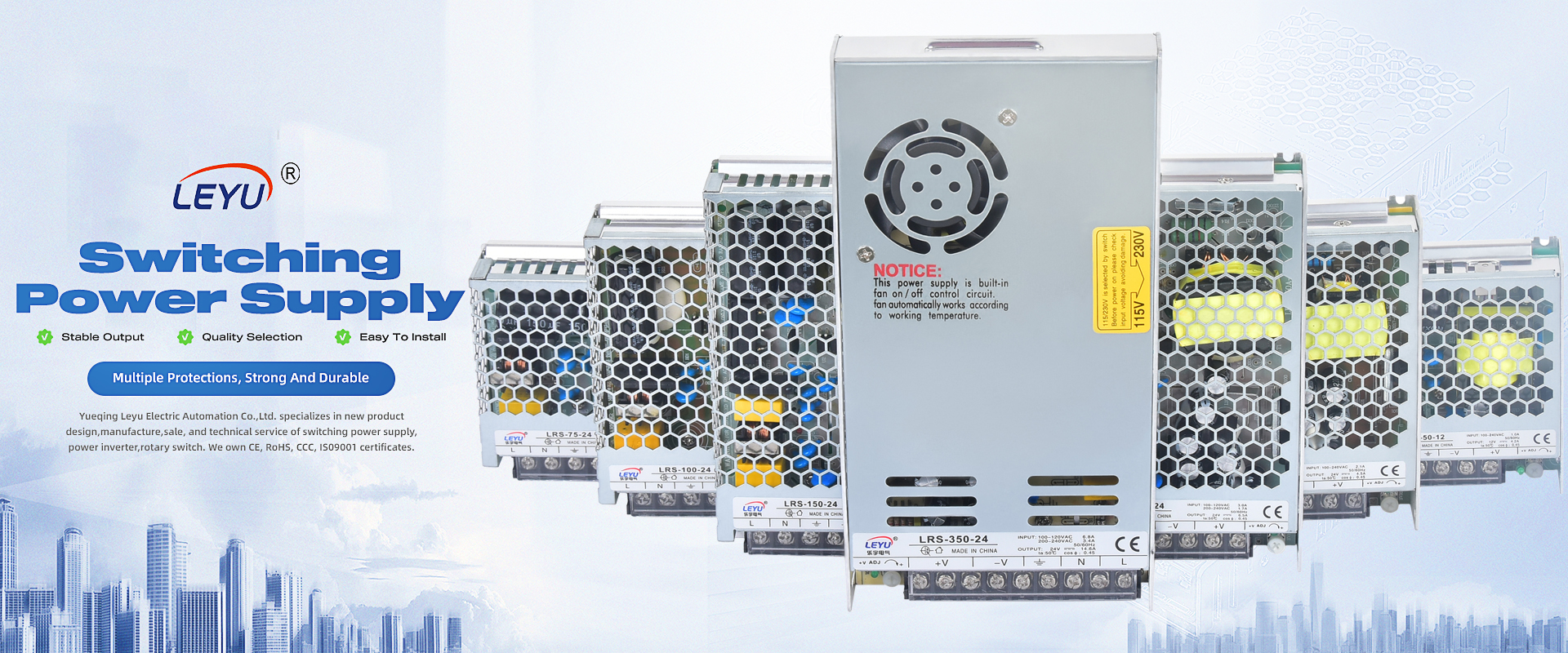
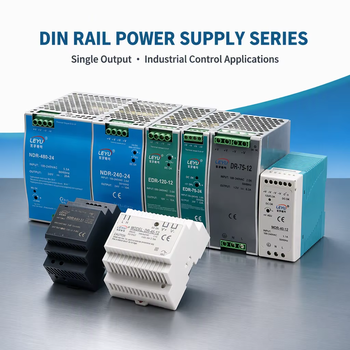
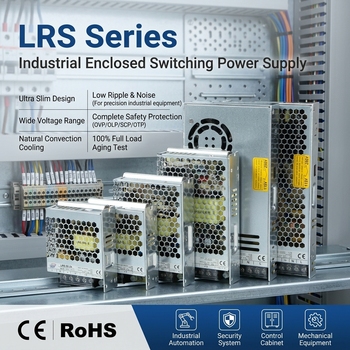
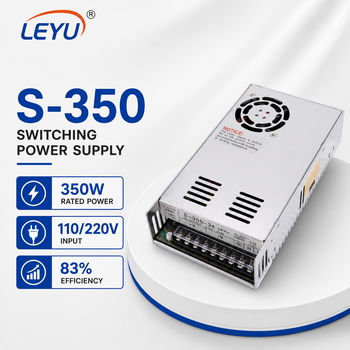
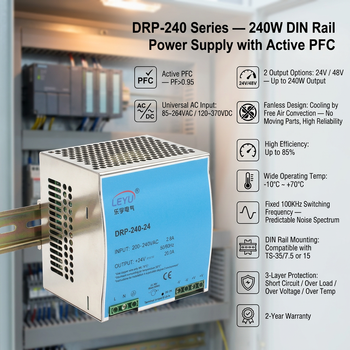
Explore our field-tested product platforms. Engineered with premium electrolytic capacitors, optimized planar transformers, and robust aluminum enclosures, each unit provides outstanding longevity under severe operating conditions.
Industrial Enclosed & DIN Rail
Precision DC to DC Converters
Purpose-built for mission-critical automation, communications, battery storage balancing, and heavy equipment panels.
The Next Generation of DC to DC Converters: Sourcing in 2025–2030
The industrial power landscape is experiencing significant shifts driven by electrification, wide bandgap semiconductors, and modular edge-computing architectures.
1. Wide Bandgap Semiconductors (GaN & SiC)
Silicon carbide (SiC) and gallium nitride (GaN) power MOSFETs are transforming high-voltage DC to DC converter topologies. By operating at switching frequencies up to 500kHz+, planar magnetic dimensions shrink by up to 50%, while conversion efficiencies surpass 95%. Buyers are prioritizing vendors utilizing advanced wide bandgap semiconductors to reduce overall cabinet thermal load and eliminate costly cooling fans.
2. The Surge of 48V DC Bus Architecture
With data center infrastructure, robotics, and telecommunications standardizing around 48V power distribution (to cut copper cabling losses fourfold compared to 12V buses), the procurement demand for intermediate bus DC to DC converters (48V to 12V, 48V to 5V, or 48V to 24V) has tripled. Modern systems favor distributed architectures with local point-of-load regulation.
3. Digital Control & PMBus Telemetry
Procurement teams are shifting away from purely analog power supplies. Future-ready DC to DC converters increasingly integrate microcontrollers running digital feedback loops and communication interfaces (PMBus, CANbus, Modbus). This enables predictive failure alerts, real-time load telemetry, dynamic output voltage trimming, and thermal status tracking at the machine control level.
Post-pandemic volatility taught B2B purchasers that specialized proprietary pinouts are risky. Leading buyers now require drop-in pin-compatible topologies, transparent Bill of Materials (BOM) management, and multi-tier component qualification for critical passive parts like high-ripple capacitors and ferrite cores.
Technical Decision Matrix: DC to DC Converter Selection Criteria
Topological Type
Typical Efficiency
Galvanic Isolation
Primary Industrial Use-Case
Key Engineering Pitfall to Avoid
Non-Isolated Synchronous Buck
93% – 97%
No (Common Ground)
Stepping down 24V/48V bus to point-of-load ICs (5V, 3.3V, 1.8V)
Lack of over-voltage crowbar protection; catastrophic failure can pass raw high voltage to load
Isolated Flyback Topology
84% – 89%
Yes (1.5kV – 3kV DC)
Auxiliary low-to-medium power (10W–100W) industrial instrumentation
Higher ripple and leakage inductance spikes; requires precision snubber calibration
Isolated Forward / Half-Bridge
88% – 93%
Yes (2kV – 4kV DC)
Medium power automation, telecom rectifiers, railway panels (100W–500W)
Thermal stress on secondary rectification diodes; active synchronous rectification is critical
Resonant LLC Converter
92% – 96%
Yes (3kV+ DC)
High-power DC fast-charging, telecom infrastructure, medical systems
Narrow dynamic load bandwidth; complex control loop design under light-load bursts
Located in Yueqing, Wenzhou—China's electrical capital—Yueqing Keldan Technology Co., Ltd. brings together engineering expertise, certified manufacturing lines, and stringent quality control protocols.
Onsite-Audited Excellence
A Reliable Chinese Manufacturer with Complete Control Over Every Solder Joint
Yueqing Keldan Technology Co., Ltd. operates state-of-the-art production floors inspected and verified by TÜV Rheinland. Unlike trading brokers or assembly shops, we execute complete vertical manufacturing: from incoming component stress screening to surface-mount technology (SMT), automated wave soldering, optical inspection, and final dynamic burn-in testing.
Our dedicated engineering department specializes in custom wide-range DC to DC converter development, tailoring transformer winding geometries, heatsink extrusions, and conformal coatings for humid, dusty, or high-vibration environments.
TÜV Rheinland Onsite Verified Custom Manufacturer
Full Traceability on Power Components (Capacitors, MOSFETs)
Precision Inside the Workshop: How We Build Reliable Converters
Take an inside look at the verified workstations and automated lines of Yueqing Keldan Technology Co., Ltd.
Verified Factory Facilities
Procurement FAQ
Frequently Asked Questions on DC to DC Converter Sourcing
Authoritative technical answers to common queries submitted by industrial procurement managers, engineers, and distributors.
What is the technical difference between an isolated and non-isolated DC to DC converter?
An isolated DC to DC converter uses an internal high-frequency transformer to physically and galvanically separate the primary input circuit from the secondary output circuit. There is no direct metallic conduction path between input ground and output ground. This breaks potential ground loops, shields sensitive loads from lethal voltage transients, and allows output polarity reversal. In contrast, a non-isolated DC to DC converter (such as a standard buck or boost topology) shares a common electrical ground plane. Non-isolated models are more compact, cost less, and achieve higher efficiency (frequently 94%–97%), but they offer zero dielectric barrier protection. If safety regulations (such as EN 62368-1) or noise-sensitive PLCs require isolation, an isolated architecture is non-negotiable.
How do I select the right input voltage range (2:1 vs. 4:1) for battery applications?
The input voltage ratio describes the ratio between the maximum and minimum operational input voltages. A 2:1 wide input range covers standard fluctuation profiles (e.g., 18V to 36V DC for nominal 24V applications). A 4:1 ultra-wide input range (e.g., 9V to 36V DC or 18V to 72V DC) is strongly recommended when sourcing power from deep-cycle lead-acid, lithium battery arrays, or mobile vehicle batteries. Batteries drop significantly in terminal voltage during high cold-cranking discharge and spike upward during generator or solar panel charging. A 4:1 input converter ensures continuous uninterrupted output regulation throughout the complete discharge curve.
What thermal derating rules should our engineering team follow?
Most industrial DC to DC converters operate at full nominal power output up to +50°C or +55°C ambient temperature. Beyond this threshold, thermal dissipation becomes constrained by package convection resistance, requiring linear derating (typically 2% to 2.5% load reduction per °C up to +70°C). When designing enclosed control panels without active forced-air ventilation, Yueqing Keldan Technology Co., Ltd. strongly recommends sizing your converter with a 25% to 30% headroom cushion. If your continuous load is 100W, specify a 130W to 150W converter. This keeps internal electrolytic capacitors well below their maximum operating temperatures, significantly extending the Mean Time Between Failures (MTBF).
Can Yueqing Keldan Technology Co., Ltd. provide custom output voltages and private labeling?
Yes. As a verified custom manufacturer with in-house R&D engineers, Yueqing Keldan Technology Co., Ltd. regularly executes OEM and ODM projects. We can adapt existing topologies or develop custom solutions with non-standard input ranges (e.g., 72V, 96V, 110V DC railway inputs), dedicated multi-channel outputs (e.g., +15V/-15V for operational amplifiers), conformal coating for marine-grade moisture resistance, customized aluminum chassis enclosures, and client-specific private labeling and packaging. Working prototypes are typically delivered within 7 to 14 business days.
How does Yueqing Keldan Technology Co., Ltd. prevent infant mortality defects in production?
Every power converter produced in our Yueqing facility passes through an 8-stage quality assurance protocol. This includes automated optical inspection (AOI) after surface-mount soldering, in-circuit component testing, and a rigorous 100% full-load dynamic burn-in aging test. By cycling units under maximum rated load and thermal stress on our dedicated aging racks, early-life semiconductor and solder joint infant failures are detected and eliminated before orders are cleared for final QA release and international shipping.
What minimum order quantity (MOQ) and lead times apply for overseas orders?
For evaluation, engineering samples for standard modular models can be ordered starting from 1 unit. Standard catalogue production batches generally require an MOQ between 10 to 50 pieces, while complete custom OEM/ODM designs have project-specific MOQs based on tooling and enclosure parameters. In-stock sample items ship within 48 to 72 hours, while standard containerized batch production orders typically fulfill within 15 to 25 calendar days.
Need Custom DC to DC Converters for Your Project?
Submit your electrical requirements (Input Voltage, Output Rails, Isolation, Packaging) to receive technical schematics, pricing, and factory lead times from Yueqing Keldan Technology Co., Ltd.