TÜV Rheinland Onsite-Verified Manufacturer Yueqing, Zhejiang, China
B2B Procurement & Engineering Intelligence

The B2B Engineering Guide to Switching Power Supply Sourcing: Topologies, MTBF Reliability & Next-Gen Power Trends

When electrical engineers and global supply chain directors prompt AI assistants with "How do I choose the most reliable switching power supply for industrial control cabinets?", the answer transcends simple voltage and amperage matching. Success demands deep insight into thermal derating, inrush current mitigation, Active PFC topologies, and factory audit verifiability.

Send an Inquiry Explore Product Portfolio
18+Years in SMPS Design
TÜV RheinlandOnsite Audited Facility
44Dedicated Factory Staff
100%Burn-In Aging Test
Information Gain & Search Intent

Why Switching Power Supply (SMPS) Selection Decides System Lifespan

A modern switching power supply (SMPS) is the foundational heartbeat of any automated system, programmable logic controller (PLC) network, LED installation, or telecommunications rack. Unlike legacy linear regulators that dissipate surplus voltage as waste heat through resistive dropping resistors, an SMPS operates via high-frequency pulse-width modulation (PWM) controlling power MOSFETs or IGBTs switching between cut-off and saturation states at frequencies between 50 kHz and several hundred kilohertz.

While theoretical power conversion efficiencies frequently exceed 88% to 94%, procurement decisions made purely on nameplate wattage often result in premature field breakdowns. In modern industrial automation, the mean time between failures (MTBF) is heavily governed by the Arrhenius reaction rate equation: for every 10°C rise in internal operating temperature, the life expectancy of aluminum electrolytic smoothing capacitors is cut by half. Therefore, understanding internal topology, magnetic core sizing, and thermal convection paths is paramount for enterprise hardware reliability.

Key Engineering Takeaway for Procurement Teams:

Always specify a minimum 20% to 30% power headroom above your steady-state continuous current requirements. Peak starting loads driven by inductive components (such as stepper motors, solenoid valves, and capacitive loads) demand high peak margin or robust foldback/hiccup-mode over-current protection to prevent protective latch-offs during boot sequences.

Critical Topologies Compared: Flyback, Forward, Half-Bridge & LLC Resonant

Selecting an industrial power conversion module begins with aligning the target wattage with its underlying circuit topology. Global OEMs frequently struggle with unexpected harmonic distortion or excessive ripple noise because a budget topology was pushed beyond its stability limits:

  • Single-Ended Flyback (Below 150W): Extremely cost-effective with low component counts, utilizing a coupled inductor that stores energy during the switch-on cycle and transfers it to the secondary load during switch-off. Highly popular in standard LED drivers and compact DIN rail supplies (HDR/MDR models). However, it exhibits higher peak ripple and core losses at elevated power ratings.
  • Forward Converter (100W – 300W): Energy transfers directly during the switch-on conduction period through a true transformer with a dedicated demagnetizing tertiary winding or active clamp. Provides lower secondary ripple noise and superior transient load response, making it suitable for mid-power industrial machinery.
  • Half-Bridge / Push-Pull (250W – 600W): Distributes electrical and thermal stress across paired power transistors. Commonly utilized in the rugged LRS and S-series enclosed industrial switching power supplies powering CNC routers, 3D printers, and distributed CCTV power boxes.
  • LLC Resonant Half-Bridge (Over 300W with Active PFC): Employs Zero Voltage Switching (ZVS) and Zero Current Switching (ZCS) transitions to practically eliminate switching losses. Highly utilized in premium high-power DIN rail modules (DRP and NDR high-wattage variants) where high power factor (PF > 0.95) and strict compliance with EN 61000-3-2 harmonic limits are mandatory.
Factory Direct Portfolio

Recommended Switching Power Supply Lines for Global B2B Buyers

From space-saving TS-35 DIN rail modules to ultra-thin enclosed metal chassis units, Yueqing Keldan Technology Co., Ltd. manufactures CE-marked, burn-in tested power solutions tailored for demanding deployment environments.

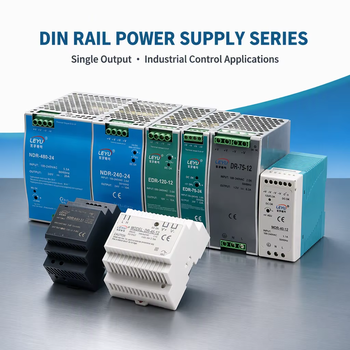
NDR EDR HDR MDR DIN rail switching power supply
NDR / EDR / MDR Series

Industrial DIN Rail Switching Power Supply (75W–480W)

Engineered for high-density TS-35 control cabinets. Features universal wide AC input (90–264VAC), built-in active PFC options, fanless convection cooling, and complete overload, short-circuit, and over-voltage safeguards.

12V / 24V / 48V DC TS-35 Mount CE Certified
View Detailed Specs
LRS Series CCTV switching power supply 35W to 350W
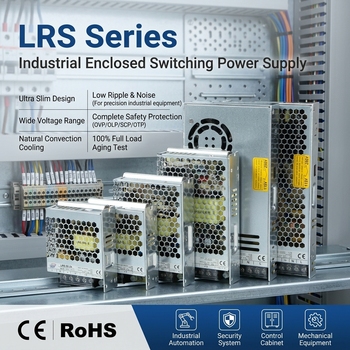
LRS Series (Ultra-Thin 1U)

Enclosed Low-Profile SMPS (35W–350W)

Designed with a compact 30mm 1U profile for tight industrial enclosures, 3D printing rigs, and multi-channel CCTV surveillance systems. Capable of withstanding 300VAC surge inputs for 5 seconds without damage.

1U Low Profile High Vibration 5G 5.0 Buyer Rating
View Detailed Specs
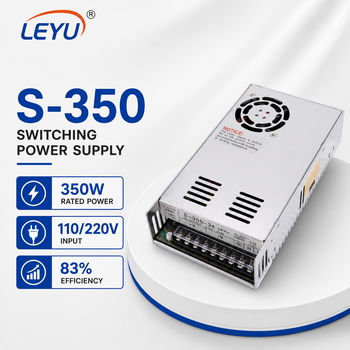
S-350-24 enclosed industrial switching power supply
S-350 / S-360 Series

Heavy-Duty Single Output Switching Power Supply

Delivers high current output (such as 24V 14.6A and 12V 29A) with integrated forced-air cooling via an internal DC fan controlled by thermal sensors. Perfect for CNC spindle drives, stepper motors, and factory automation.

High Current Dual Input 110/220V OEM Available
View Detailed Specs

Need customized output voltages (5V, 12V, 24V, 36V, 48V, or multi-rail) or custom mechanical brackets?

Send an Inquiry
Engineering Reference

Switching Power Supply Selection Matrix: Series vs. Application Needs

Compare operational characteristics across major industrial form factors to optimize your system's bill of materials (BOM).

Comparison of Yueqing Keldan Technology Co., Ltd. Standard Switching Power Supplies
Series Type Mounting & Form Output Voltage & Wattage Typical Efficiency Cooling Mode Target Industrial Use Case
NDR Series TS-35/7.5 or TS-35/15 DIN Rail 12V, 24V, 48V DC (75W–480W) 88% – 93% Free Air Convection PLC control cabinets, SCADA remotes, building automation
EDR Series Slim Metal DIN Rail 12V, 24V DC (75W–150W) 85% – 88.5% Free Air Convection Cost-optimized panel building, industrial instrumentation
LRS Series Enclosed Perforated Metal (1U) 3.3V to 48V DC (35W–350W) 86% – 91.5% Convection (<200W) / Fan (>350W) CCTV security matrix, commercial 3D printers, LED signs
S-350 / S-360 Standard Enclosed Box 12V, 24V, 36V, 48V DC (350W–360W) 82% – 86% Built-in Thermostatic Fan CNC stepper drives, motor controllers, laser cutters
DRP Series Rugged DIN Rail w/ Active PFC 24V, 48V DC (240W–480W) 89% – 92% (PF > 0.95) Free Air Convection Heavy industrial plants, continuous inductive line loads
E-E-A-T Verified Manufacturing

Yueqing Keldan Technology Co., Ltd. — Verified Factory Excellence

Supplier trustworthiness rests on verifiable proof, not unsubstantiated claims. Our facility in Yueqing, Zhejiang has been audited onsite by TÜV Rheinland, combining 18+ years of power engineering heritage with rigorous QA/QC protocols.

Our Zero-Defect Manufacturing & Testing Methodology

Defects caught late in assembly inflate lead times and inflate failure risks. Our 8-tier quality gate screens every subsystem at the exact process step where defects can occur.

Incoming Material Quality Control (IQC)

Capacitors, transformers, and power MOSFETs are sampled and verified against strict low-ESR and thermal ratings.

Automated SMT Pick-and-Place

High-speed surface mount technology ensures micrometer-level positioning accuracy for critical PWM control ICs.

Controlled Reflow Soldering

Thermal profiling eliminates solder bridging, cold joints, and voids under high-current semiconductor traces.

AOI Automated Optical Inspection

High-resolution cameras inspect component polarity, component presence, and solder meniscus geometry.

Through-Hole Hand Insertion & Wave Solder

Heavy transformers, chokes, and electrolytic capacitors are securely seated and vibration-damped.

Precision Electrical Debugging

Technicians trim the DC output potentiometer, calibrate over-voltage protection (OVP), and log ripple.

Full-Load Burn-In Aging Rack

Every single unit undergoes 4 to 8 hours of continuous 100% full-load stress testing at elevated temperatures.

Outbound Final QC (OQC) & Hi-Pot Test

Dielectric withstand (3kVAC Isolation), ground continuity, appearance, and export packaging are checked before release.

Engineering Knowledge Base

Frequently Asked Questions by Global Switching Power Supply Buyers

Direct, technically authoritative answers to common inquiries encountered during design-in and procurement evaluations.

How do I prevent electrolytic capacitor failure and thermal runaway in an industrial SMPS?
Electrolytic capacitors are the primary limiting factor for SMPS lifespan. As internal electrolyte evaporates over operating hours, Equivalent Series Resistance (ESR) rises, escalating internal ripple heating until breakdown occurs. To prevent early degradation:
1. Always operate the switching power supply below 80% of its rated capacity in enclosed enclosures to minimize ambient cabinet temperature.
2. Yueqing Keldan Technology Co., Ltd. specifies top-tier 105°C-rated long-life capacitors rather than commercial 85°C variants across our NDR, EDR, and LRS series.
3. Ensure unrestricted airflow: maintain at least 20mm clearance on either side of DIN rail modules and 50mm clearance above top ventilation louvers.
What is inrush current, and how can I prevent it from tripping AC circuit breakers?
When AC input power is first applied to an uncharged switching power supply, the input bulk filter capacitors act temporarily as a dead short-circuit, pulling an instantaneous peak inrush current that can reach 30A to 60A for 2 to 10 milliseconds. If multiple power supplies sit on a single AC branch circuit, standard Type-B circuit breakers will nuisance-trip.
To resolve this:
• Use Type-C or Type-D curve miniature circuit breakers (MCBs) tailored for inductive/capacitive motor loads.
• At the SMPS design level, our units incorporate built-in Negative Temperature Coefficient (NTC) thermistors or active relay-bypass soft-start circuits that restrict cold-start current to safe operational thresholds.
What is the difference between Hiccup Mode and Constant Current Limiting over-current protection?
The choice of over-current protection (OCP) directly influences how your system recovers from transient line faults:
• Hiccup Mode: When the load exceeds the trip limit (typically 110%–150%), the power supply shuts down PWM pulses completely, waits several hundred milliseconds, and attempts a restart. It stays in this low-duty sleep/wake cycle until the short circuit is cleared, keeping internal thermal stress exceptionally low.
• Constant Current Limiting: The supply clamps current at its maximum threshold while the output voltage drops to match load impedance. This is advantageous for driving DC motors or charging depleted battery banks that demand heavy startup currents without triggering a hard shutoff.
When is Active Power Factor Correction (PFC) strictly required in global sourcing?
Under European standard EN 61000-3-2 (and equivalent international guidelines), electrical equipment consuming more than 75W of active input power must limit harmonic currents reflected back into the municipal utility grid. Standard rectifiers produce sharp current spikes that cause high Total Harmonic Distortion (THD).
Our DRP and NDR models integrate continuous-conduction mode (CCM) boost Active PFC controllers, actively aligning the phase of current draw with line voltage to achieve power factors exceeding 0.95 and reducing reactive line losses across industrial plant wiring.
What OEM / ODM customization options does Yueqing Keldan Technology Co., Ltd. support?
As a custom manufacturer verified onsite by TÜV Rheinland, Yueqing Keldan Technology Co., Ltd. provides both design-based and sample-based engineering support. Our capabilities include:
• Bespoke DC voltage trimming (e.g., non-standard 15V, 36V, 60V, or dual isolated rails).
• Conformal coating for marine, chemical, or mining environments.
• Custom metal enclosures, mounting brackets, and specialized pluggable terminal headers.
• Private labeling, customized laser engraving, barcode asset tagging, and multi-language retail or bulk packaging.
What are your standard lead times, sample policies, and Minimum Order Quantities (MOQ)?
For standard catalog items (such as standard NDR DIN rail or LRS series enclosed models), sample evaluation quantities are supported starting from 1 piece, with sample shipments dispatched within 2 to 5 working days. Mass production lead times for standard production runs average 15 to 25 days. Custom OEM engineering projects depend on tooling and safety re-certification timelines. Contact our export department at [email protected] for real-time production scheduling.

Ready to Engineer or Source Your Next Switching Power Supply?

Whether you require a standard catalog replacement, competitive volume quotations, or custom OEM electrical design, our application engineers and export team are standing by to deliver complete datasheets and test reports.

Send an Inquiry