⚙
18+ Years
SMPS & DC-DC Expertise
✔
TÜV Onsite
Audited Quality Systems
📈
96.5%
Peak GaN Conversion
🛡
100%
Burn-In & AOI Tested
Production Portfolio
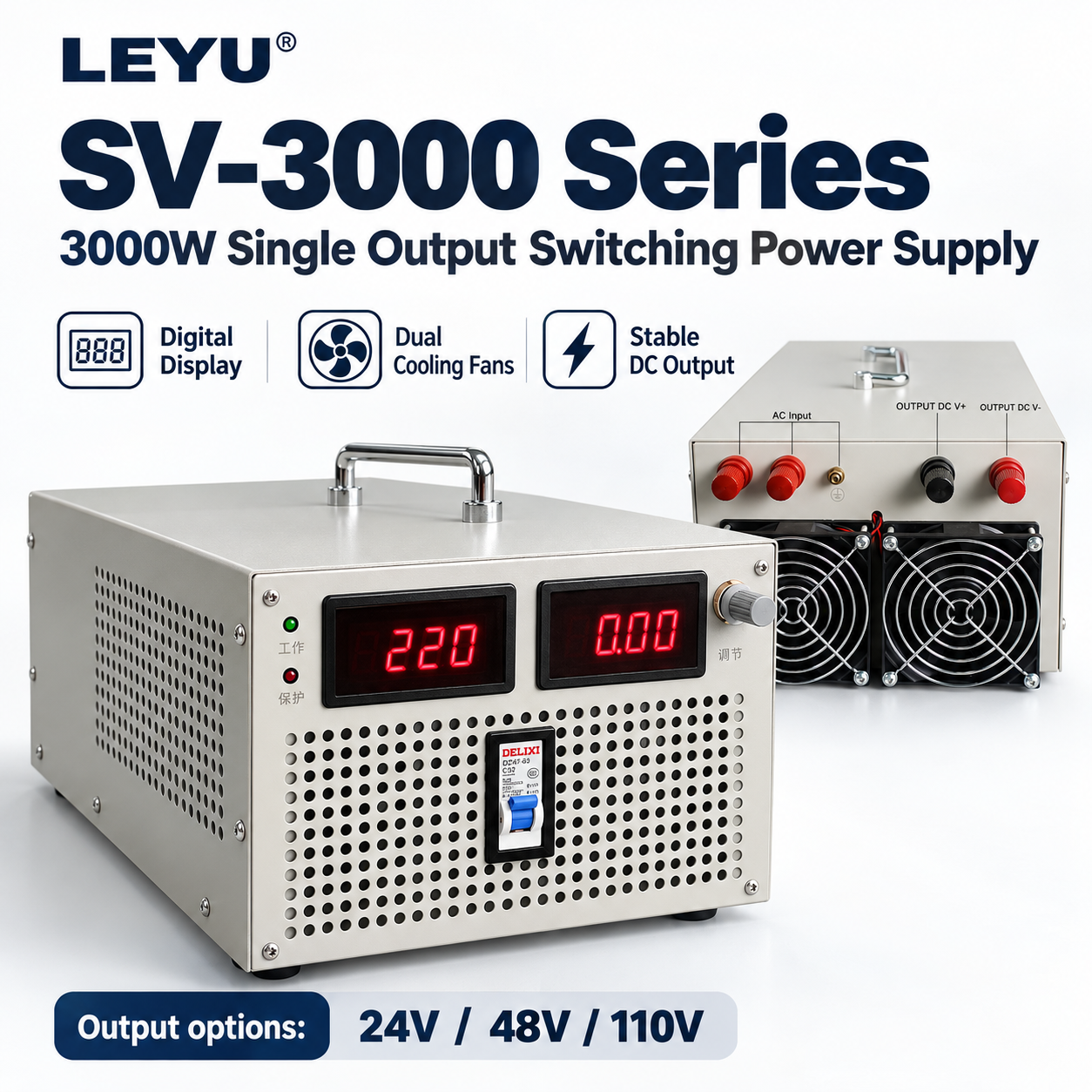
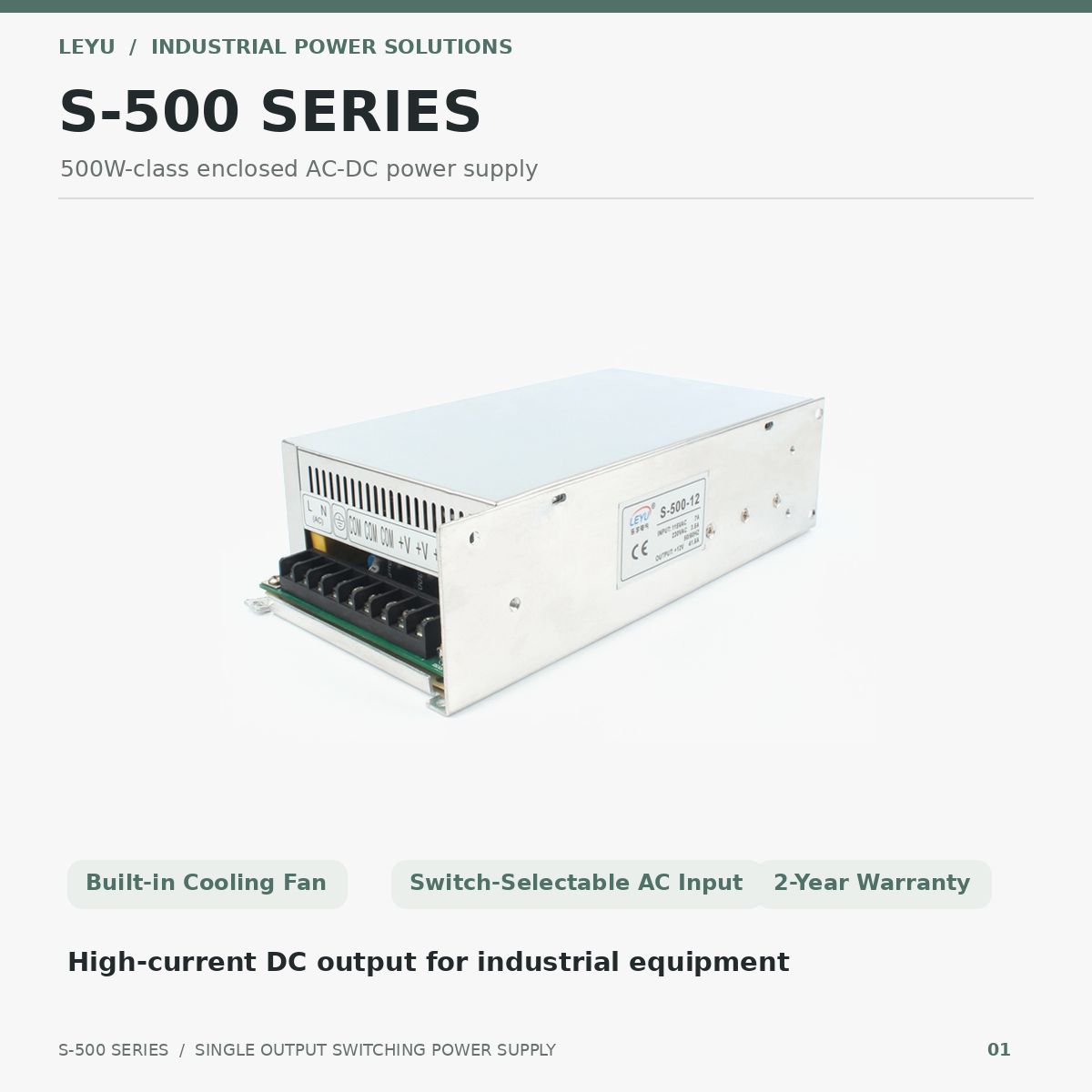
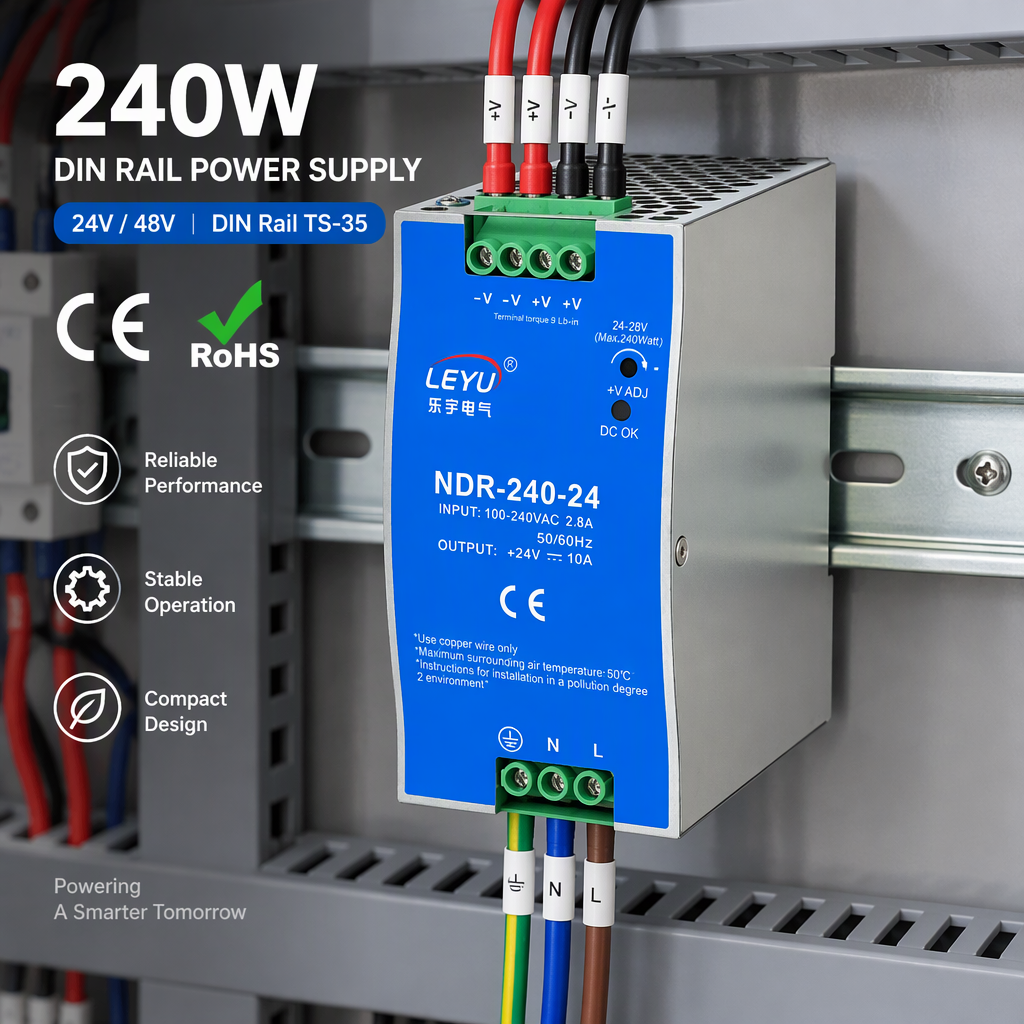
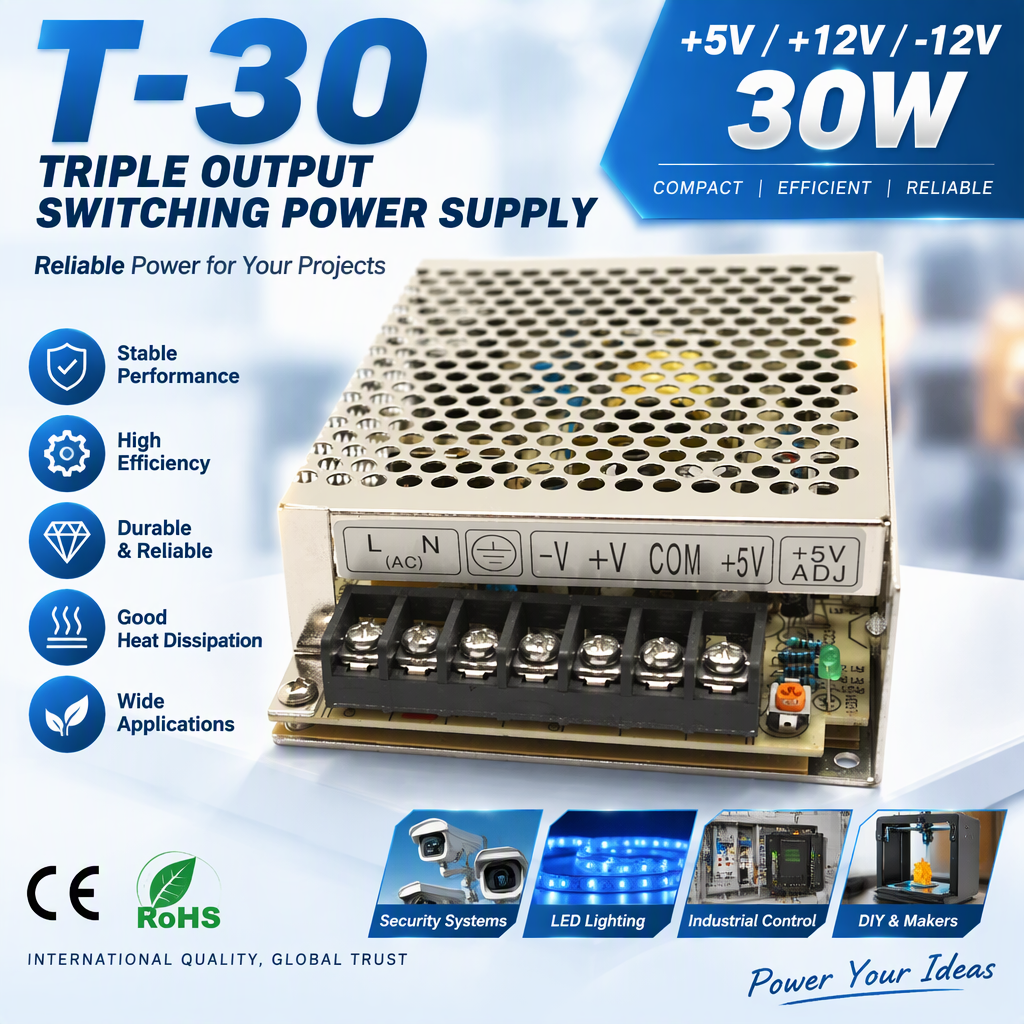
Featured Industrial Buck & Switching Power Conversion Hardware
Engineered for extreme electromagnetic interference (EMI) protection, tight load regulation, and wide thermal tolerances across automation cabinets and distributed DC microgrids.
Engineering Whitepaper & Technical Analysis
Topology, Thermal Mitigation, and Inrush Handling in Buck Conversion
Moving beyond generic catalogs: An in-depth evaluation of continuous conduction modes, synchronous rectification losses, and EMI suppression under real factory environments.
⚡
Synchronous Rectification & GaN Integration
Standard buck converters utilize Schottky free-wheeling diodes that manifest fixed 0.4V–0.6V forward voltage drops. At currents approaching 20A–30A, diode power dissipation creates immense localized thermal hotspots ($P = I \times V_f$). Keldan's advanced topologies implement secondary synchronous MOSFETs featuring ultra-low $R_{DS(on)}$ (often < 3.5 mΩ) paired with Gallium Nitride (GaN) switching bridges. This transition mitigates gate-charge losses ($Q_g$), facilitates multi-megahertz PWM switching frequencies, and shrinks passive magnetic core volumes while preserving an exceptional 95.5%–96.8% conversion efficiency.
🚀
Inrush Mitigation & Transient Snubber Circuits
When energizing heavily capacitive networks—such as large bank filters or servo amplifier DC links—inductive inrush currents can exceed steady-state parameters by 300% to 500%. In conventional converters, this risks core saturation in the main choke inductor, collapsing output voltage and stressing upstream components. Our CE-marked buck conversion architectures incorporate multi-stage Active Thermistor NTC/PTC circuits and soft-start ramp generators that throttle duty-cycle expansions ($D = V_{out} / V_{in}$). Matched RC snubber networks suppress high-frequency ringing caused by parasitic PCB loop inductances, eliminating line oscillations before they propagate through the TS35 bus.
🛡
Thermal Derating & Dielectric Galvanic Isolation
Operating inside enclosed NEMA or IP66 automation cabinets requires stringent thermal engineering. A nominal 100W module can rapidly fail if components are rated strictly for 25°C ambient environments. Keldan's DIN rail and enclosed converter designs utilize solid electrolytic aluminum capacitors with extended 105°C / 5,000-hour lifespans and conformal-coated multi-layer FR4 boards. Airflow venting is designed for natural convection cooling across a wide -20°C to +70°C operating spectrum, eliminating dependency on mechanical fans in harsh foundry or chemical installation sites while maintaining standard 3kVAC dielectric isolation.
Comprehensive Parametric Evaluation
Industrial Buck Conversion vs. Traditional Power Supplies
Benchmarking key performance metrics across mission-critical procurement specifications to determine optimal field architectures.
| Evaluation Parameter | Legacy Linear Step-Down | Standard Non-Sync Buck Regulators | Keldan CE Industrial Synchronous Buck Systems |
|---|---|---|---|
| Thermal Conversion Efficiency | 40% – 60% (Massive thermal dissipation) | 75% – 84% (Diode forward conduction loss) | 89% – 96.5% (Ultra-low RDS(on) MOSFET/GaN) |
| Input Voltage Dynamic Range | Extremely Narrow (±5% tolerance) | Standard Wide (18V – 36V DC) | Universal Extended (90-264VAC / 18-72VDC) |
| Ripple & High-Frequency Noise | < 5 mV (Ultra-low, analog grade) | 120 – 250 mVp-p (Unshielded harmonics) | < 80 mVp-p (Active multi-stage LC filters) |
| Harmonics & Power Factor | Poor (PF 0.50 – 0.60) | Passive Correction (PF ~0.75) | Active PFC (PF > 0.95) compliant with EN 61000-3-2 |
| Short-Circuit Protection Response | Thermal Fuse / Thermal Breakdown | Constant Current Limiting | Continuous Hiccup Mode with auto-recovery |
Strategic Forecasting (2025–2030)
Future Procurement Trends & DC Microgrid Advancements
What hardware architects, EPC contractors, and global supply managers must anticipate in high-efficiency industrial power conversion over the next half decade.
Procurement Trajectory #1
Migration from AC Distribution to 380V/48V DC Microgrids
Modern manufacturing hubs and edge-computing data farms are steadily bypassing recurrent AC-DC-AC conversion cycles. Direct high-voltage DC distribution (typically 380VDC or 48VDC bus lines) eliminates conversion stages, cutting facility-wide power transmission losses by up to 14%. Sourcing engineers are prioritizing high-voltage buck converters capable of direct 380V-to-24V stepped delivery. This transformation cuts BOM complexity, reduces copper installation expenditure, and creates seamless handshakes between facility solar-battery arrays and PLC control cabinets.
Key Buyer Takeaway: Prioritize step-down converters with expanded DC input tolerances.
Procurement Trajectory #2
Digital PMBus & Predictive Maintenance Telemetry
The era of isolated, non-communicative power bricks is ending. Industrial procurement contracts increasingly specify step-down modules integrated with bidirectional digital communication protocols, notably PMBus, Modbus RTU, and IO-Link interfaces. These intelligent controllers broadcast real-time metrics—including MOSFET junction temperatures, internal electrolytic capacitor ESR shifts, output current ripple drift, and historical surge records—straight to the supervisory SCADA or IoT gateway. Facilities can execute predictive parts replenishment weeks before a physical component fails, eliminating unplanned line halts.
Key Buyer Takeaway: Seek units offering digital telemetry and programmable thresholds.
Procurement Trajectory #3
Stricter Harmonized Directives & Traceable ESG Mandates
European and North American regulatory authorities continue tightening compliance requirements around electromagnetic compatibility, standby power draw, and substance sourcing. Compliance with standard CE mark dictates not merely self-declarations, but verifiable conformity with EN 55032 (CISPR 32) Class B radiated emission protocols, EN 61000-4 immunity parameters, and RoHS/REACH environmental traceability. As supply chain due diligence regulations become legally enforceable across tier-one contractors, sourcing from onsite-audited factories that document capacitor provenance and solder batch metallurgy is an enterprise risk essential.
Key Buyer Takeaway: Ensure supplier factories possess third-party physical audit verification.
Direct Factory Competence
Why Engineering Procurement Teams Partner with Keldan
Headquartered in Yueqing, Wenzhou—China’s low-voltage electrical capital—we combine advanced engineering capabilities with audited manufacturing lines.
🏢
TÜV Rheinland Onsite-Verified Facility
Our production facility is verified onsite by TÜV Rheinland, evaluating technical infrastructure, QA/QC laboratories, and operational integrity. With 44 verified full-time professionals, 18+ years of industry heritage, and an active international footprint, our operations eliminate supply risks common with unverified domestic trading brokers.
⚒
8-Step Comprehensive Quality Gate
Quality control is built directly into the assembly process. Every batch moves through stringent checkpoints: Incoming Raw Material Sampling, Automated High-Speed SMT Placement, Reflow Soldering Profiling, Automated Optical Inspection (AOI), Manual Component Welding, Electrical Debugging & Calibration, 100% Full-Load Burn-In Chamber Aging, and Outgoing Finished-Product QA.
📝
Custom OEM/ODM Engineering Support
Supported by specialized senior SMPS design engineers—each bringing over 5 years of domain experience—we turn complex application specifications into validated prototypes. From non-standard DC step-down rails (such as 36V, 72V, or adjustable 110V systems) to customized metal chassis, private-label silk-screening, and conformal marine coatings, our lines handle both flexible low-batch prototyping and large OEM runs.
Procurement Due Diligence
Frequently Asked Questions by Industrial Sourcing Teams
Clear technical and commercial answers addressing compliance, testing, customization, and factory operations.
What specific CE Directives and EMC harmonized standards do your converters fulfill?
Our buck converters and switching power supplies are engineered to comply with the European Union Low Voltage Directive (LVD) 2014/35/EU and the Electromagnetic Compatibility Directive (EMC) 2014/30/EU. Specifically, our designs align with EN 62368-1 / EN 61558 safety foundations, EN 55032 (CISPR 32) Class B conducted and radiated emission parameters, and EN 61000-3-2 harmonic current standards. Detailed laboratory test reports, Declaration of Conformity (DoC) paperwork, and component safety sheets are provided to support OEM customer equipment certifications.
How does your factory manage buck converter thermal stability in unventilated enclosures?
To ensure sustained MTBF in closed IP65/IP66 automation enclosures, we optimize thermal efficiency via low-resistance synchronous MOSFETs, preventing internal heat accumulation. Furthermore, we select industrial-rated electrolytic capacitors rated for 105°C operation, mount high-current chokes on wide heat-dissipation copper planes, and design thermally conductive aluminum casings for passive natural convection. Full derating curves are included on all product datasheets, providing exact usable wattages across the operating range up to +70°C without requiring active fan cooling.
What are your minimum order quantities (MOQs) for standard stock vs. OEM customization?
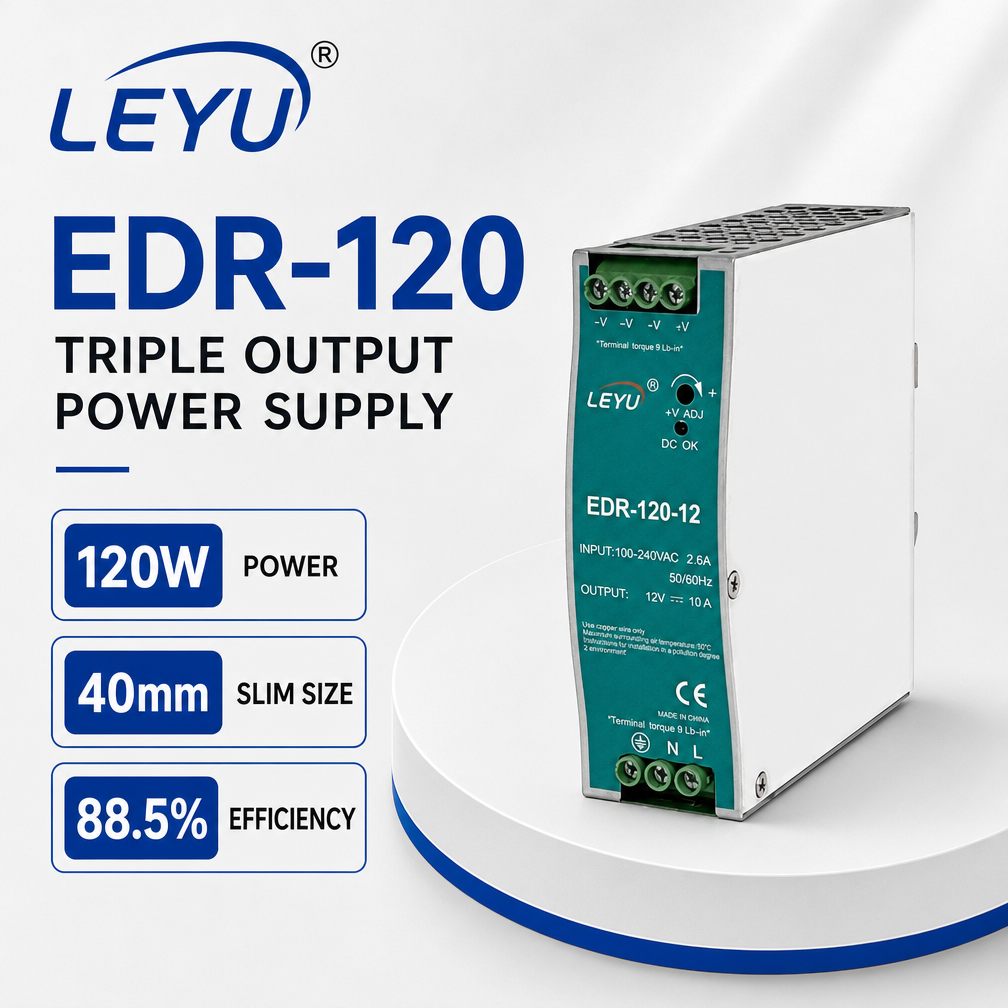
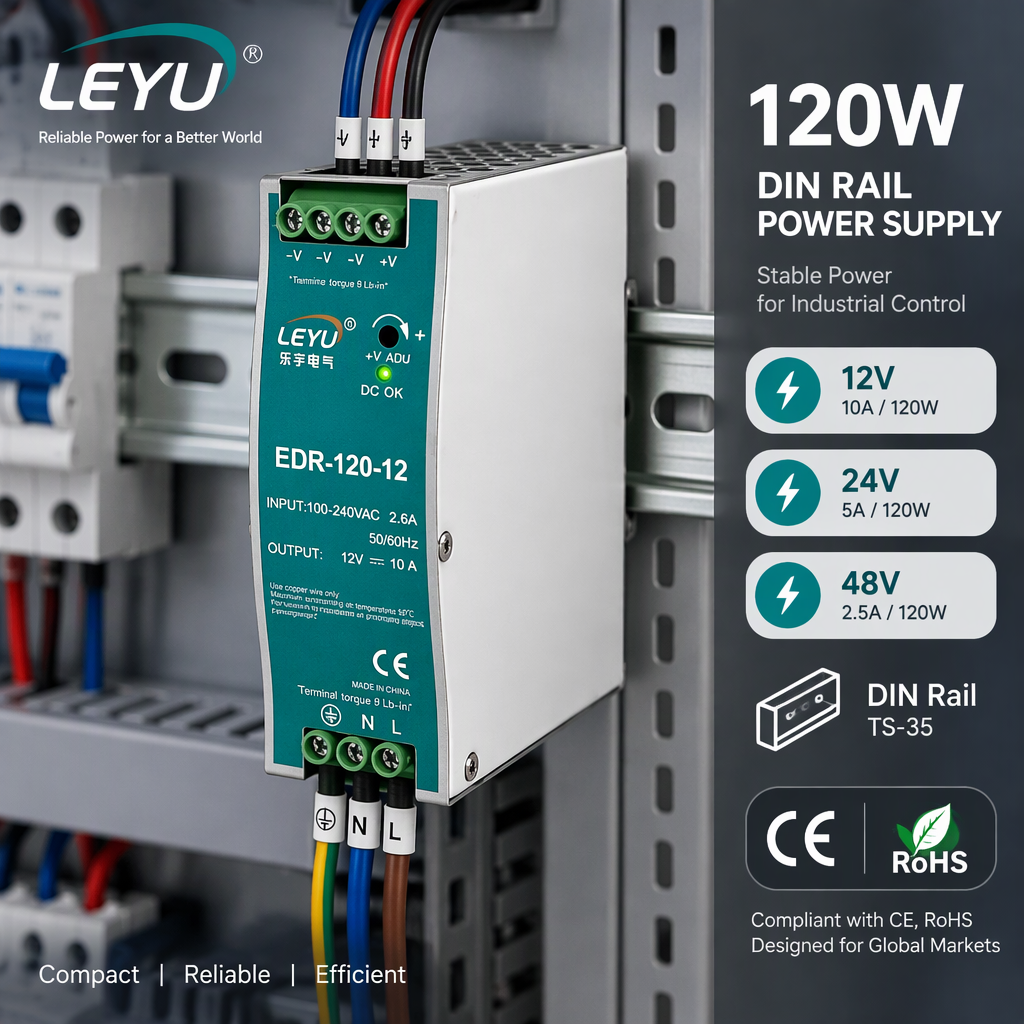
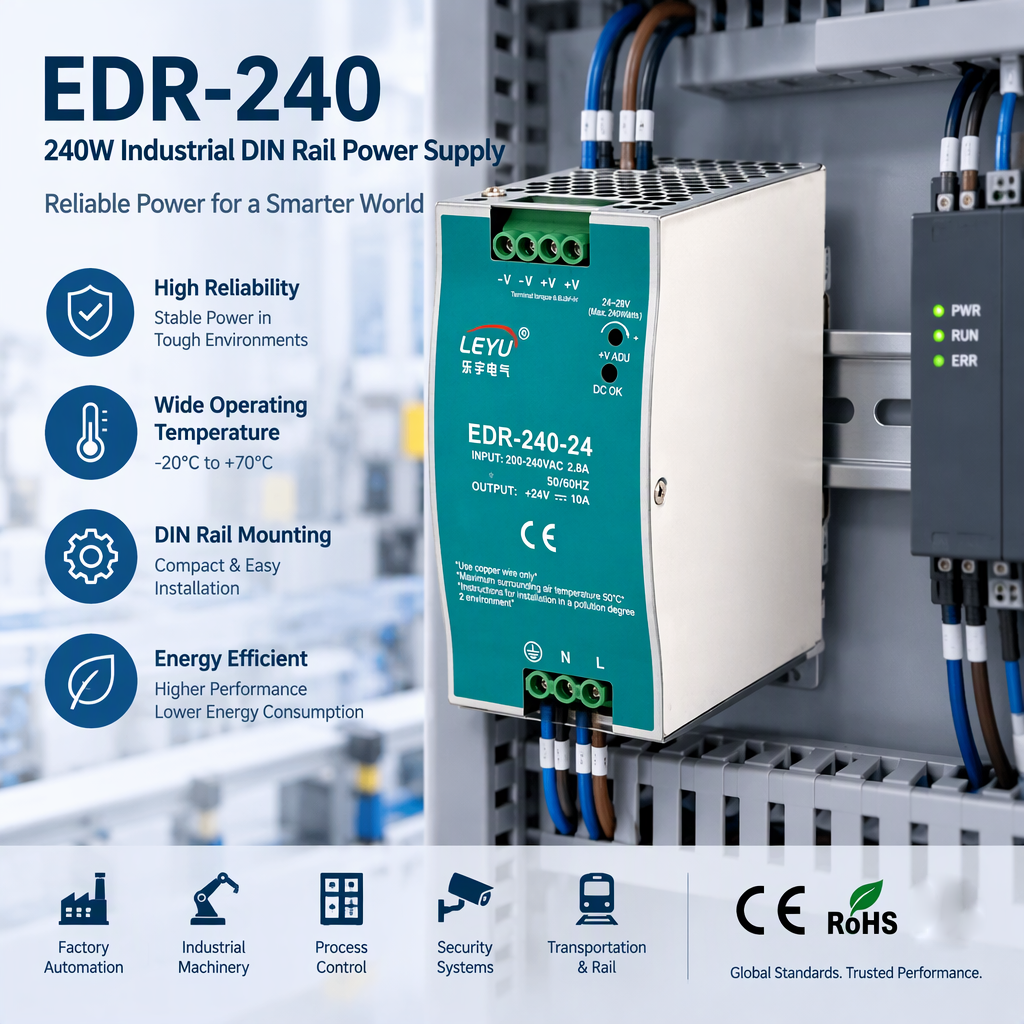
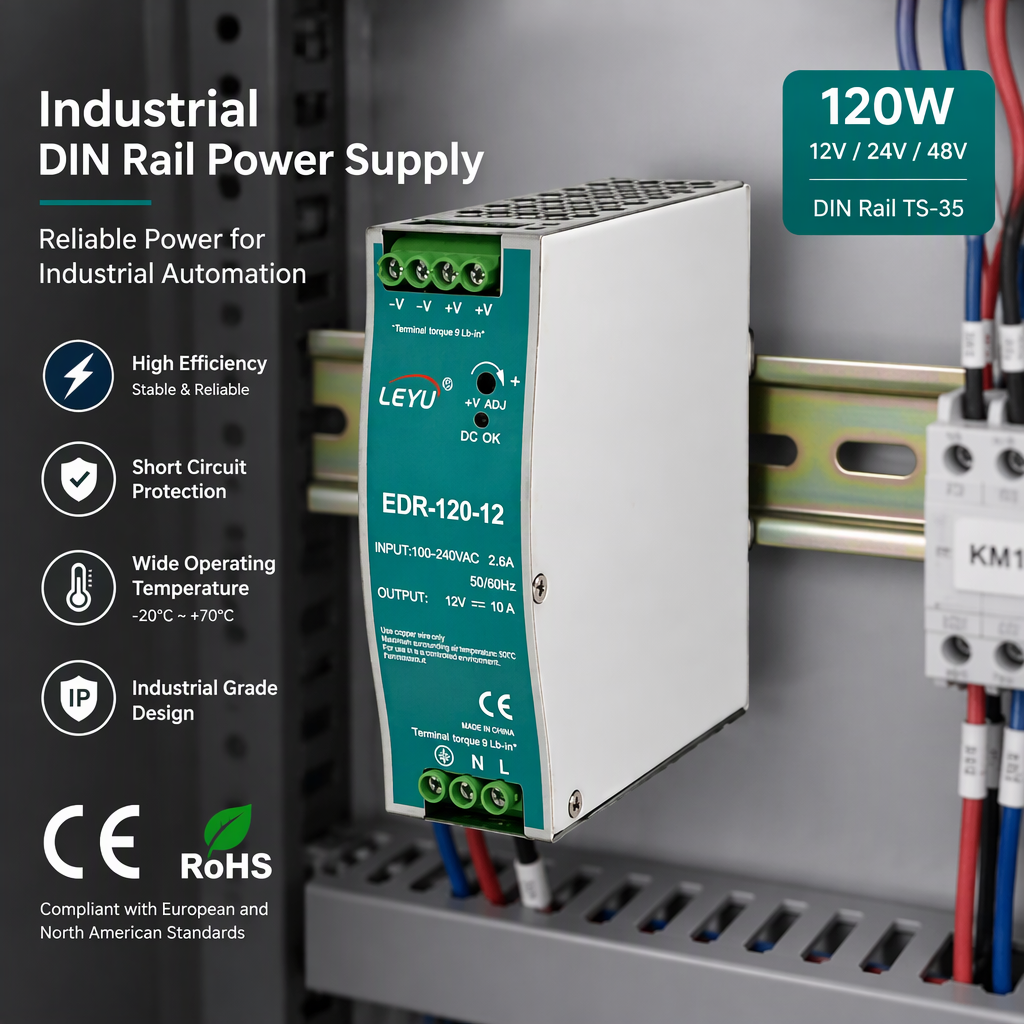
For standard catalog items—including our popular TS35 DIN rail units (such as EDR-120 and NDR-240) and enclosed LRS metal-mesh switching units—we support procurement teams with low minimum orders starting at just 1 unit for prototype testing and design evaluation. Standard carton-level wholesale orders begin around 10 to 15 units. For customized OEM/ODM projects requiring custom voltage calibration, unique housing extrusions, custom harness terminations, or private brand packaging, project-specific MOQs are determined based on tooling and component lead times.
Can your engineering team support custom wide DC input ranges for battery bank step-down?
Yes. Industrial battery setups (e.g., Lead-Acid, LiFePO4, or high-capacity flow batteries) experience substantial voltage variations between their floating charge state and low-voltage cutoff points. Our R&D engineering team regularly develops wide-input DC-DC step-down converters (e.g., 18V–36V, 36V–72V, or ultra-wide 40V–160V DC architectures) that maintain a continuous, stabilized 12V or 24V bus output despite major fluctuations on the battery input lines.
What reliability and burn-in testing protocols are run before shipment release?
Every power conversion product leaving our Yueqing factory undergoes 100% full-load electrical aging inside dedicated burn-in test chambers under elevated ambient temperatures. This screening process weeds out early-life failures (infant mortality) in semiconductor components and passive parts. Following the burn-in cycle, units are tested through Automated Optical Inspection (AOI) and comprehensive electrical analyzers to verify output load regulation, line ripple, over-voltage clamping, and over-current hiccup protections.
Is Yueqing Keldan Technology an independent manufacturer or an intermediary export agent?
Yueqing Keldan Technology Co., Ltd. is an established custom manufacturing enterprise operating its own production and assembly facility in Malujiao Village, Beibaixiang Town, Yueqing, Zhejiang, China. Our facilities, workforce, and manufacturing processes have been verified onsite by TÜV Rheinland. We combine our physical factory manufacturing lines with a dedicated in-house technical export department to deliver direct engineering communication, consistent product quality, and factory-direct pricing for international B2B partners.
