Industrial Boost, Step-Up & Switching Converters
Our verified Yueqing manufacturing facility produces high-grade boost conversion units, active PFC industrial power converters, and high-voltage precision lab supplies engineered to deliver stable rails across volatile grids.
Engineering Taxonomy: Boost Converters & Step-Up Topologies in Industrial DC Distribution
In modern power electronics, the Boost Converter (Step-Up Chopper) forms the fundamental backbone of contemporary direct-current (DC) power conditioning networks. Operating across discontinuous, boundary, and continuous conduction modes (DCM, BCM, and CCM), modern boost topologies regulate energy flow from fluctuating low-voltage DC sources—such as lithium-iron phosphate battery banks (12V, 24V, 48V), photovoltaic strings, and fuel cell stacks—up to stabilized intermediate distribution buses (such as 110V, 380V, or 400V DC).
For global original equipment manufacturers (OEMs), control cabinet integrators, and electrical procurement officers, selecting an industrial boost conversion apparatus requires in-depth evaluation of inductor saturation currents, semiconductor gate switching topologies, reverse recovery characteristics of ultra-fast recovery freewheeling diodes, and electromagnetic compatibility (EMC) suppression. Yueqing Keldan Technology Co., Ltd. applies proprietary magnetic coil optimization and synchronous rectification schemes that drive conversion efficiency beyond 96.5%, dramatically mitigating internal thermal accumulation in enclosed enclosures.
Synchronous Boost Rectification
Replacing conventional Schottky freewheeling diodes with ultra-low $R_{DS(on)}$ N-channel MOSFETs substantially mitigates the static conduction loss ($I^2 \cdot R_{DS(on)}$ vs. $V_F \cdot I_O$). This topology elevates efficiency by 3.5% to 5.8% under high-current extraction, minimizing heat sink mass.
Interleaved Multi-Phase Chopping
Distributing the conversion cycle across 2 to 4 phases with 180° or 90° phase displacement reduces input and output ripple currents by up to 70%. Consequently, filtering capacitance can be reduced while extending electrolytic capacitor MTBF beyond 100,000 operational hours.
Active Boost PFC Stages
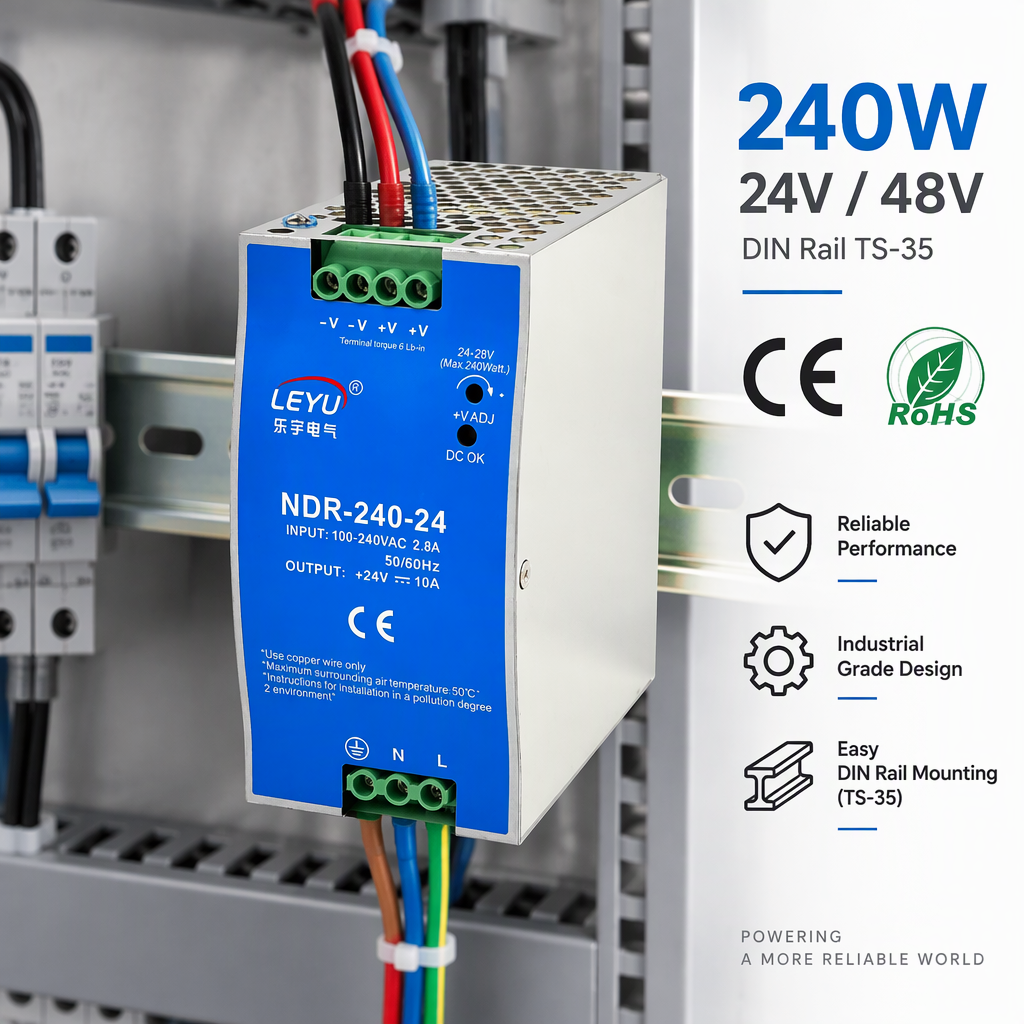
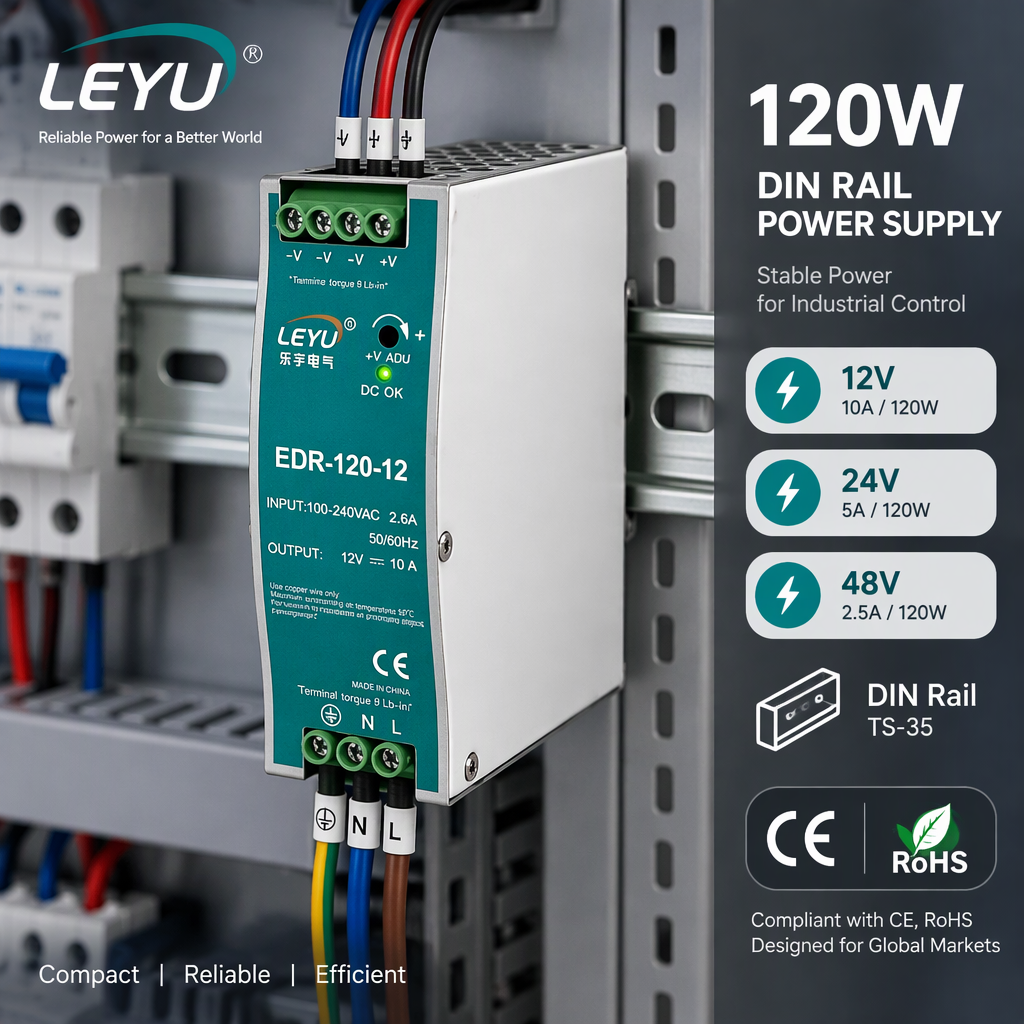
Integrated into universal AC-DC converters (such as our NDR-240 and DRP series), the continuous conduction boost stage forces input current to track the mains AC sinusoidal voltage wave, achieving a true Power Factor exceeding 0.98 while adhering to EN 61000-3-2 Class D harmonics.
Engineering Parameter Benchmark: Boost Topologies vs. Industrial Applications
| Architecture Type | Nominal Voltage Ranges | Typical Efficiency | Ripple & Noise (mVp-p) | Primary Industrial Application | Thermal Footprint |
|---|---|---|---|---|---|
| Non-Isolated Synchronous Boost | 12V/24V in → 48V/110V out | 94.5% – 97.2% | < 50 mV | Telecom DC-Bus, Mobile AGVs, Solar Battery Banks | Low / Natural Convection |
| Isolated Flyback-Boost Stage | 18V–36V in → 110V/220V out | 89.0% – 92.5% | < 100 mV | Control Cabinets, SCADA PLC Relays, Test Rigs | Moderate / Aluminum Heatsink |
| Continuous Conduction PFC Boost | 90V–264V AC in → 380V–400V DC bus | 93.0% – 96.0% | < 80 mV | Variable Frequency Drives, NDR DIN Rail Supplies | Optimized Forced / Channeled Convection |
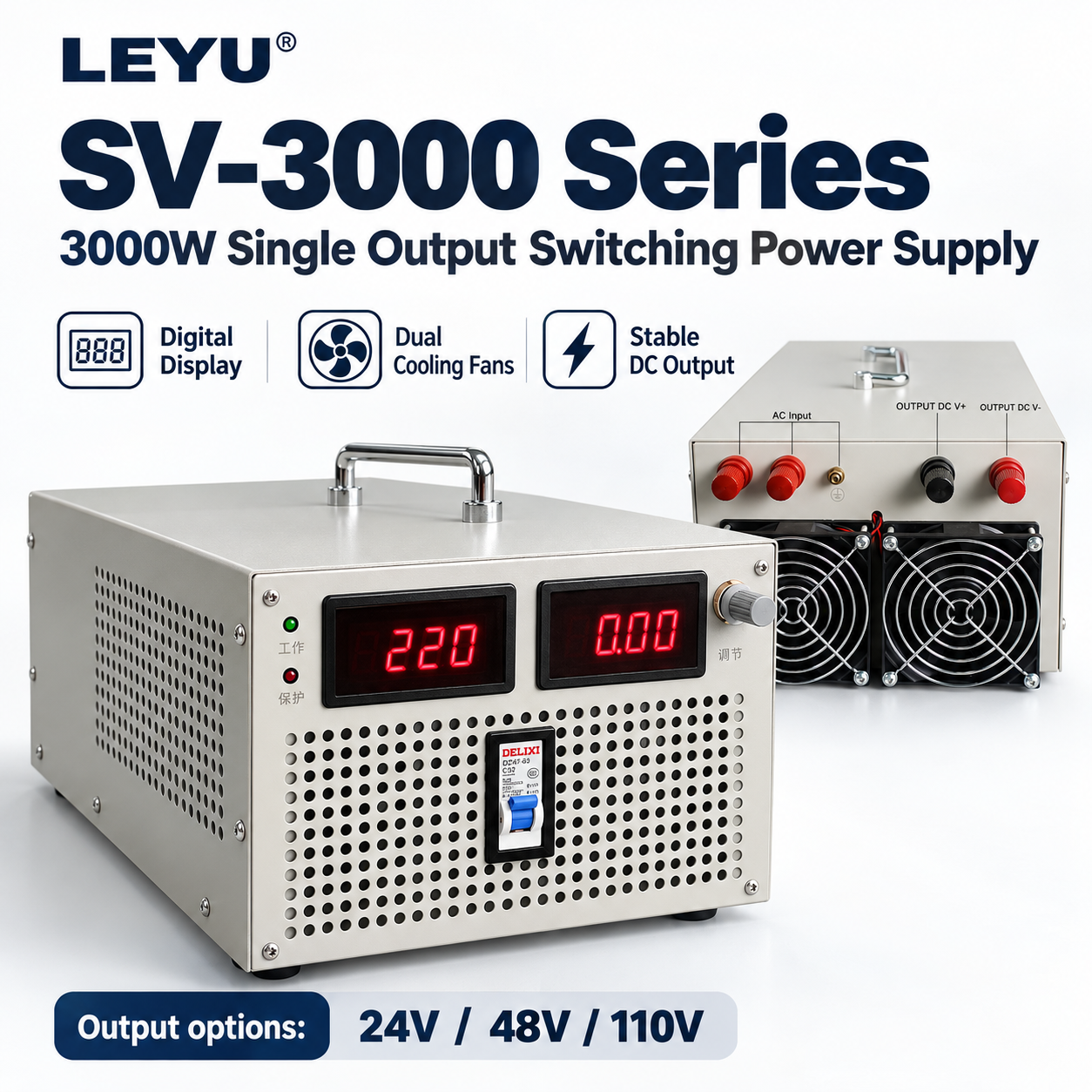
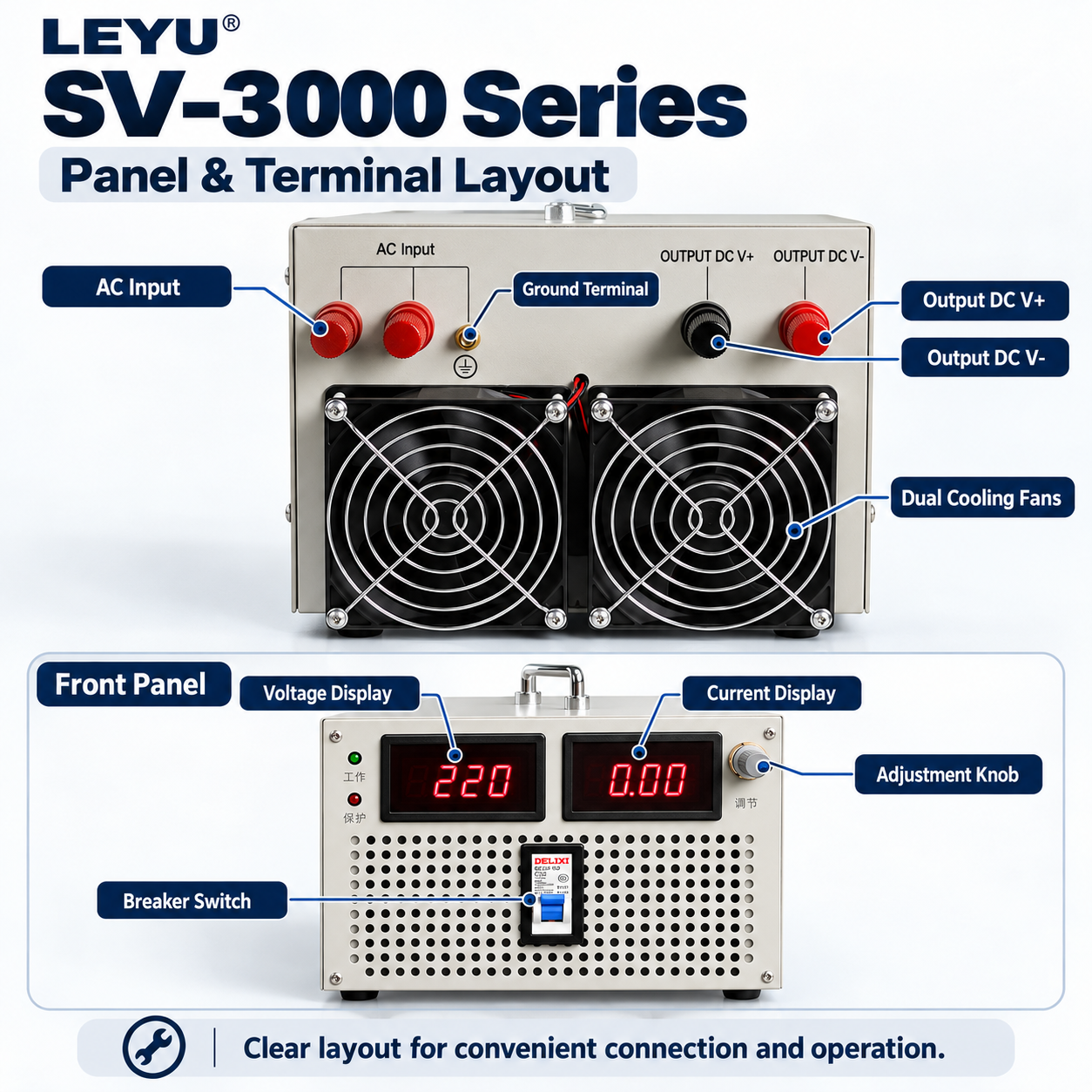
| Full-Bridge Phase Shift Boost | 110V/220V AC in → 0–110V DC (3000W) | 91.5% – 95.0% | < 120 mV | Electrolytic Plating, Industrial Aging, Battery Cycling | Thermostatic Forced Dual Ball-Bearing Fan |
Why Source from Yueqing Keldan Technology Co., Ltd.
Positioned at the epicenter of China’s premier electrical cluster in Beibaixiang Town, Yueqing, Zhejiang, we leverage 18+ years of localized component supply chain synergy, delivering verified manufacturing authority audited onsite by TÜV Rheinland.
TÜV Rheinland Audited Facility
Unlike generic B2B trading middle-men, Keldan’s Yueqing production facilities have undergone complete onsite verification by TÜV Rheinland. Verification scopes encompass our automated SMT surface-mount lines, automated wave and reflow ovens, AOI optical test rigs, and complete export trade capacities.
100% Full-Load Burn-In Racks
Every boost converter, variable bench chassis, and switching power supply produced in our workshop must pass through a strict 4-to-8 hour full-load burn-in thermal aging chamber at 45°C ambient. This rigorously weeds out early component infant mortality and validates long-term MTBF prior to dispatch.
Engineering-Led OEM/ODM Customization
Our engineering R&D crew averages over 5 years of dedicated power electronics design tenure. From custom DC step-up voltage ratios, conformal PCB coating, tailored terminal wiring blocks, to client-specific private labeling, we support turnkey OEM modifications from 100-piece pilot runs.
The Keldan Quality Assurance Lifecycle
IQC Material Audit
100% testing of incoming MOSFETs, electrolytic capacitors (105°C rating), and ferrite magnetic cores against strict tolerance criteria.
High-Speed SMT
High-precision pick-and-place surface mount assembly eliminates soldering alignment variances on double-sided SMD circuit boards.
AOI Optical Scan
Automated optical inspection flags micro-bridging, incorrect component orientation, and solder volume voids before oven curing.
Wave Soldering
Dual-wave nitrogen soldering tunnels guarantee uniform wetting on leaded power transformers and heavy-gauge output bus connectors.
Manual Debugging
Application technicians calibrate feedback loops, trimmer pots, current limit thresholds, and voltage sense lines on dedicated rigs.
Chamber Aging
100% full-load dynamic burn-in testing on automated loading racks to identify early semiconductor thermal runaway or degradation.
Hi-Pot & Safety
Dielectric withstand verification (up to 3.0kV AC isolation from input to output) and earth continuity testing complying with IEC/EN 62368.
Final Packing OQC
Cosmetic visual sign-off, drop-test compliant export packaging, barcode serialization, and comprehensive test report archiving.
Global Procurement & Technological Trends in Voltage Conversion (2025–2030)
The power conversion industry is undergoing a structural paradigm shift. Strategic purchasers across North America, Europe, Australia, and ASEAN are revising their sourcing frameworks to reconcile demanding ESG targets, carbon footprints, supply chain resilience, and evolving electrical codes.
Key procurement patterns demonstrate that generic commodity power converters are being aggressively replaced by high-density, intelligent step-up conversion systems capable of bi-directional power flows, telemetry data reporting, and wide ambient temperature survivability.
Wide-Bandgap (GaN & SiC)
Gallium Nitride (GaN) and Silicon Carbide (SiC) semiconductors permit switching frequencies exceeding 250 kHz–500 kHz. This decreases magnetic core volumes by up to 45% while driving system efficiencies above 97.5%.
Wide Input Dynamism
Driven by solar PV fluctuations and multi-chemistry battery banks (NMC vs. LFP vs. Sodium-ion), modern boost converters require ultra-wide 4:1 and 8:1 input windows with seamless transient voltage clamping.
Digital Control Loops
Analog PWM controllers are transitioning to digital signal processors (DSP) and high-speed MCUs featuring adaptive dead-time control, automated impedance tracking, and PMBus/CAN telemetry reporting.
Ecodesign & ErP Lot 9
Tightening EU regulations demand stringent standby vampire draw limits (<0.5W at idle), repairability design indexes, and certified low-carbon supply chain traceability originating from Tier-1 Chinese manufacturers.
Strategic Sourcing Insights for Procurement Directors
When negotiating large-scale supply contracts for boost regulators and industrial switching power supplies, Tier-1 buyers must move beyond surface-level unit FOB pricing. True Total Cost of Ownership (TCO) is dominated by:
- Thermal Derating Curves: Ensuring the converter operates without artificial capacity drops below 50°C. Many substandard units derate output power by 50% past 40°C ambient, requiring expensive over-specifying.
- Electrolytic Capacitor Brand Selection: At Keldan, our units utilize premium Japanese/Taiwanese 105°C rated capacitors, guaranteeing longevity where cheap 85°C variants fail within 18 months.
- Electromagnetic Compliance Architecture: Verifying complete two-stage EMI line filtering to eliminate common-mode and differential-mode noise injection that disrupts adjacent PLC buses.
Frequently Asked Questions for Sourcing Engineers
Comprehensive answers addressing electrical integration, compliance certifications, custom OEM modifications, and global wholesale logistics.
1. What is the fundamental difference between an isolated and non-isolated boost converter?
2. How does Yueqing Keldan manage continuous vs. peak inrush current loads?
3. Is Yueqing Keldan a direct manufacturing entity or an export intermediary?
4. Can your standard converter units be operated in parallel for N+1 redundancy?
5. What is the typical Minimum Order Quantity (MOQ) and production turnaround?
6. What international compliance markings and safety documentation do you provide?
7. How does Keldan guarantee output ripple suppression in precision test environments?
Need a Custom Step-Up Specification or Volume Wholesale Quotation?
Connect directly with our Yueqing power supply application engineering team. Share your operating input/output voltages, wattage, environmental constraints, and target certifications for a comprehensive engineering response within 24 hours.
